
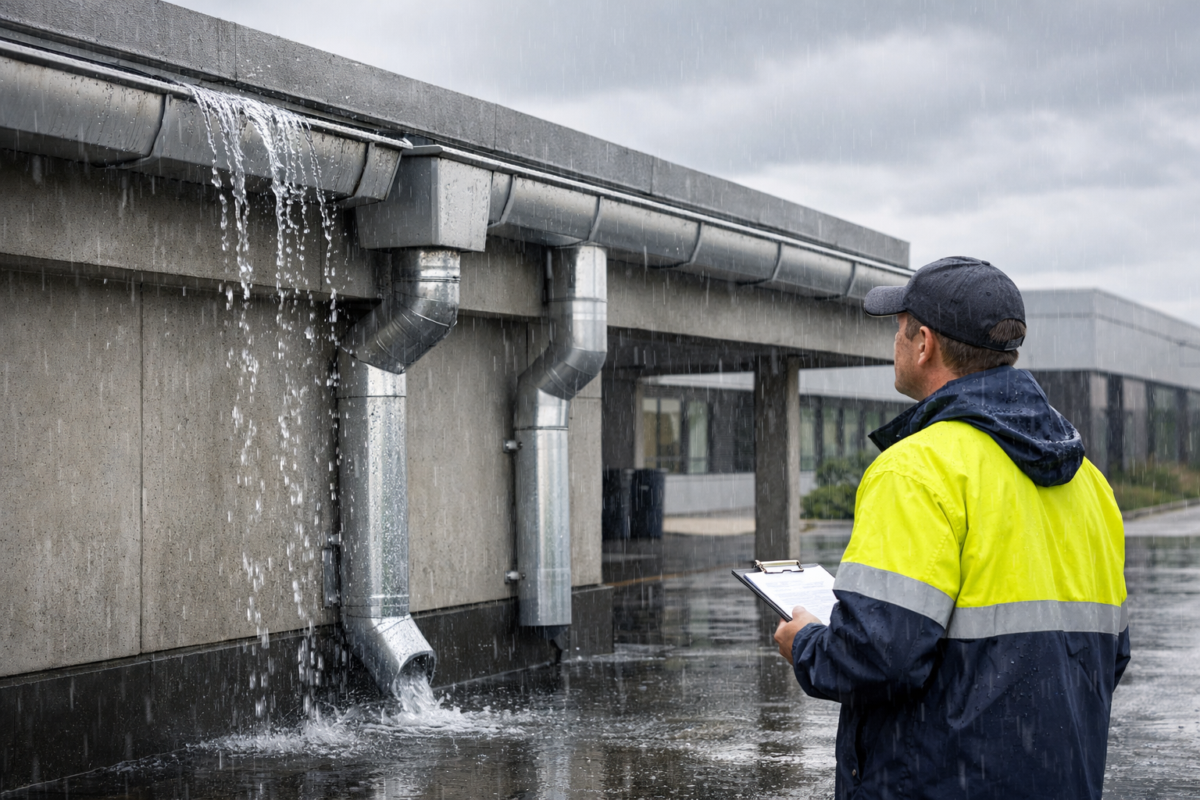
A lot of attention goes into planning and executing a commercial gutter installation. The sizing, the routing, and the downspout placement take real thought. But once the crew packs up and the system is in place, the work for a property manager isn’t over. If anything, that’s when a different kind of attention starts.
Commercial gutters are designed to handle significant water loads and protect the building over the long term. Whether they actually do that depends largely on whether the people responsible for the property are watching closely enough in the early months. Small drainage issues, when caught quickly, are usually minor fixes. Left unattended, they can become structural problems.
This piece outlines what to monitor, what warning signs look like, and when it’s time to call for help.
Quick Answer Summary
After commercial gutter installation, property managers should monitor drainage flow, overflow points, structural integrity, downspout discharge, and early signs of water damage. Observing how the system performs during and after rain helps identify issues like improper pitch, clogs, or poor drainage before they develop into costly structural problems. Early detection and maintenance are key to ensuring long-term gutter performance.
Monitor #1: Drainage Flow During and After Rain
The most basic check is also the most informative. During the first few significant rain events after installation, go watch the system work. Water should be moving steadily toward each downspout and clearing the gutter completely after rain stops.
If one downspout is running while another is dry, that’s worth noting. Same if water is trickling from a seam or sitting in a gutter section an hour after the rain has stopped. Standing water after a storm usually points to a pitch issue, a partial clog, or a disconnected underground drain, none of which fix themselves.
The job of commercial gutters and downspouts is simply to move rainwater away from the building. When they’re not doing that, something in the system needs attention.
Monitor #2: Overflow Points and Concentration Areas
Overflow isn’t always obvious from the ground, but it leaves evidence, such as staining on fascia boards, watermarks on exterior walls, or soil erosion near the foundation. During moderate to heavy rain, try to observe where water spills over the gutter lip, if it does at all.
Isolated overflow at one section is different from widespread overflow across a run. The first might be a debris blockage or a small pitch problem. The second could mean the gutter is undersized for the roof area and rainfall load it’s handling, a sizing issue rather than a maintenance one.
Elbows, collector heads, and outlet areas tend to be the first places where debris slows flow. Those spots deserve extra attention, especially on systems with lots of bends or long horizontal runs.
Monitor #3: Structural Integrity and Attachment Points
After a commercial gutter installation, the system should sit firmly and evenly along the roofline. Over time, or sooner if there’s a problem, hangers can loosen, sections can sag, and seams can pull apart.
Walk the perimeter periodically and look for gutter edges that appear uneven or sections that have pulled slightly away from the fascia. Even a small gap matters because water will find it. Sagging is particularly worth acting on early. If a section sags, it creates a low point where water pools, and pooling accelerates wear on the gutter floor and any seams in that area.
Seams and elbows deserve their own check. Even on a newer installation, those are natural stress points. A small leak at a seam is a fixable problem. A seam that’s been leaking behind the gutter for months is a much bigger conversation.
Monitor #4: Downspout Discharge and Foundation Clearance
Where water lands after it leaves the downspout matters as much as how it gets there. Lateral piping should extend at least five feet from the building and slope away from the foundation. Underground catchment systems should discharge at least ten feet out.
If water is pooling at the base of a downspout or collecting near the foundation, the drainage path isn’t complete, even if the gutter itself is performing correctly. A perfectly installed commercial gutter can still cause moisture problems if the discharge location is incorrect. Check that downspout extensions are intact, haven’t shifted, and are directing water away from the structure.
Monitor #5: Early Signs of Building-Level Water Damage
Some monitoring happens from the outside. Some of it happens by paying attention to what’s going on inside. Consistent discoloration on exterior walls near gutters, soft mortar on masonry, or musty odors in perimeter spaces can all point to water bypassing or leaking behind the gutter system.
These signs often develop slowly, which is part of why they get missed. But they’re worth tracking. If you notice the same stain appearing after every rain, that pattern is telling you something about where water is going.
When to Call for Professional Commercial Gutter Repair
Not every issue you spot during monitoring needs an emergency call, but some things shouldn’t wait.
Persistent Overflow After Cleaning
If you’ve cleared debris and water is still spilling over in the same spots, cleaning isn’t the fix. The system likely has a pitch problem or was undersized for the roof area it’s handling, and that requires someone who can assess the full drainage path, not just clear out what’s visible.
Visible Sagging or Separation
When hangers fail, or the fascia behind them starts to rot, a temporary patch just delays the real problem. Commercial gutter repair at that point means correcting the support structure before a section pulls away from the building entirely.
Recurring Clogs at the Same Downspout
If the same spot keeps backing up, debris is probably bypassing the outlet screen consistently. That’s either a design issue or a sign that gutter guards would reduce the maintenance burden significantly.
Water Making It Inside the Building
And any water making it inside the building, near the roofline, along perimeter walls, anywhere? That goes straight to a professional. You’ve moved past monitoring at that point, and waiting makes it worse.
Turn Monitoring of Commercial Gutter Installation Into Protection
Installing commercial gutters is one part of protecting a building from water damage. Watching how they perform after installation is the other part. A system that gets observed during storms, after heavy rain, at seams and elbows, and downspout outlets is a system where problems get caught early, when they’re still small.
At Gutter Empire, we are here to help with professional inspections and dependable commercial gutter repair when your monitoring turns something up. Call us at (971) 777-9899, click here for a free estimate, or reach out through our contact form to schedule a service or consultation.
Key Takeaways
- Property managers should actively monitor gutter performance after installation, especially during the first major rain events.
- Water should flow evenly toward all downspouts and fully clear after rainfall, without pooling or delays.
- Overflow in isolated areas may indicate clogs or pitch issues, while widespread overflow can signal undersized gutters.
- Structural issues such as sagging, loose hangers, or leaking seams should be addressed early to prevent larger failures.
- Proper drainage requires water to be directed at least 5 feet away from the foundation, or farther with underground systems.
- Recurring clogs, uneven flow, or pooling water often point to design or installation issues, not just maintenance needs.
- Early warning signs like staining, erosion, or musty odors may indicate hidden water intrusion.
- Prompt professional repair is necessary when issues persist, especially if water enters the building or structural separation occurs.