
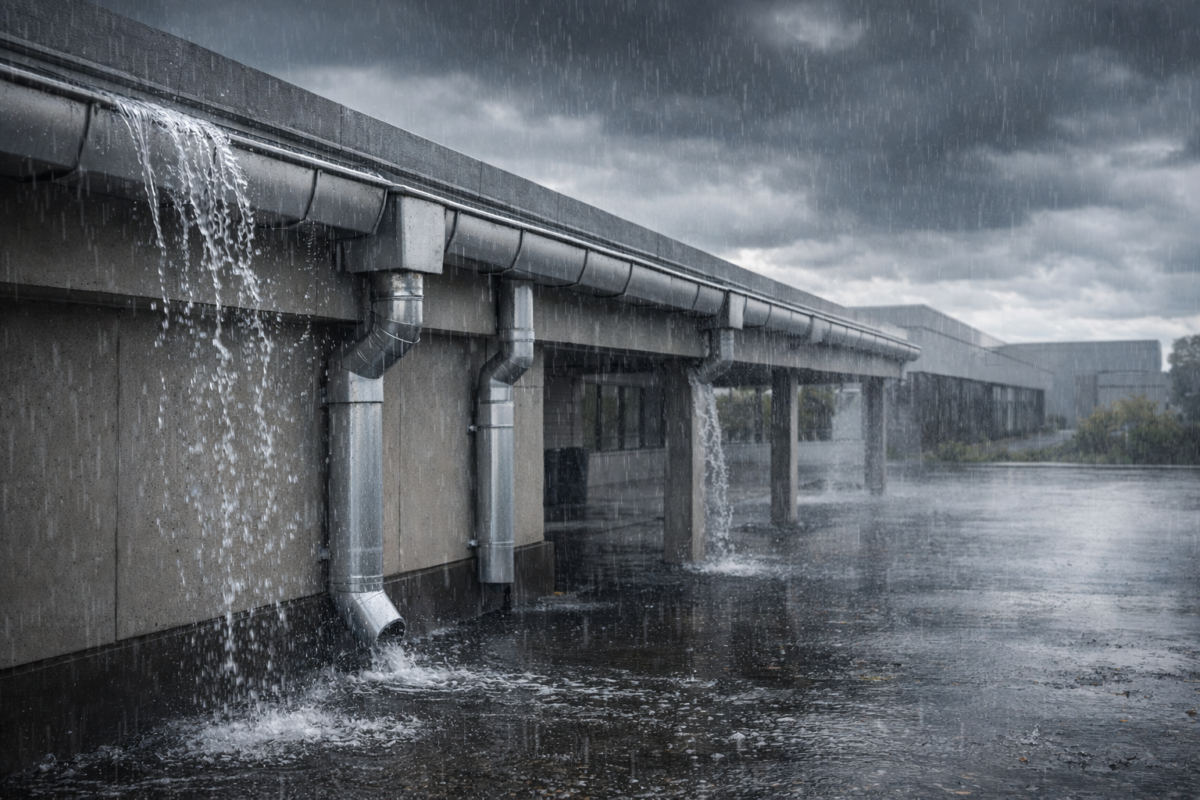
Washington doesn’t ease into its storms. In December 2025, an atmospheric river system dropped up to 10 inches of rain across parts of the state, roughly 5 trillion gallons of water over a single week, according to NASA.
For commercial property managers, events like that are a stress test. And when commercial gutters and downspouts aren’t built to handle that kind of volume, they fail in ways that reach far beyond the roofline.
The failure isn’t always dramatic. Sometimes it’s a slow leak at a seam. Other times, it’s water pooling against a foundation wall for hours after the rain stops. But the pattern is consistent: When the system can’t move the water fast enough, the problems compound.
Understanding what happens and why is the first step toward knowing whether commercial gutter repair or a full commercial gutter installation update is needed.
Quick Answer Summary
When commercial gutters and downspouts can’t handle heavy rainfall, water overflows, ponds, and accumulates near the building instead of draining properly. This leads to structural strain, foundation exposure, and long-term water damage. The root cause is usually undersized systems, poor downspout layout, or debris reducing capacity. While minor issues can be fixed with repairs, recurring overflow often signals the need for a redesigned commercial gutter system.
What Happens When Gutter Capacity Is Exceeded vs. Working Properly
The difference between a properly functioning commercial gutter system and one that is undersized or overloaded becomes clear during heavy rainfall.
| Condition | Properly Sized System | Undersized or Overloaded System |
|---|---|---|
| Water Flow | Water moves smoothly into downspouts | Water spills over gutter edges instead of draining |
| Gutter Condition | Gutters fully drain after rainfall | Standing water remains in gutter sections |
| Downspout Performance | All downspouts carry water efficiently | Some downspouts run dry while others overflow |
| Water Discharge | Water is directed safely away from the building | Water collects near foundation or wall lines |
| Structural Impact | Minimal stress on hangers and seams | Increased strain causing sagging, leaks, and separation |
| Maintenance Needs | Routine cleaning and inspections | Frequent issues requiring repairs or redesign |
| Long-Term Outcome | System performs reliably over time | Recurring overflow and potential water damage |
What Happens When Capacity Is Exceeded
Water Overflows the Gutter Instead of Draining
The most obvious sign is overflow. When runoff volume exceeds the system’s capacity, water stops entering the downspouts and spills over the front or sides of the gutter instead. On a large commercial roof, at just 1 inch of rain per hour, roughly 96 square feet of roof area generates 1 gallon of runoff per minute. The scale adds up quickly, especially on roofs where geometry, valleys, or walls draining into lower sections funnel water into a concentrated area.
Water Ponds in the Gutter or on the Roof Edge
Ponding is the next problem, and it’s a different kind of stress. Standing water left in the gutter after the rain stops indicates a problem with pitch, alignment, or outlet capacity. It also means weight. A gutter holding standing water puts real strain on hangers and seams that weren’t designed to carry that load indefinitely.
Water Ends Up Too Close to the Building
When water can’t move through the system, it must go somewhere. Usually, it ends up dropping directly next to the building, next to the wall line, near the foundation.
Industry drainage guidance says discharge should terminate at least five feet from the building and ten feet for certain underground systems. Overflow defeats that standard entirely, even if the gutters themselves are still physically attached.
The System Experiences More Strain at Hangers, Seams, Elbows, and Long Runs
Long runs compound all of this. SMACNA engineering guidance identifies 50 feet as the practical maximum gutter length for a single downspout. Buildings with longer runs and too few outlets carry more risk when rainfall intensity rises. Repeated overflow loads on the same sections accelerate wear at the very points that already experience the most stress.
Downstream Drainage Problems Follow
And once water escapes the intended drainage path, the consequences extend beyond the building envelope. Seattle’s stormwater code exists because roof runoff that reaches the ground uncontrolled can contribute to flooding, erosion, and regulatory liability.
Why Commercial Systems Fail Under Heavy Rain
The core reason is usually a mismatch between what the system was designed to handle and what fell on the roof. Washington’s storm-drainage sizing rules are based on projected roof area and local rainfall rate. If either number was underestimated when the system was installed, overload during an intense storm is essentially predictable.
Roof geometry makes it worse. Valleys, abrupt slope changes, and uninterrupted flat sections all increase the effective runoff load on a limited stretch of commercial gutters. Even a system that works fine in light rain can be overwhelmed when the roof concentrates water into a short section.
Downspout layout also matters. Industry guidance recommends spacing downspouts every 20 to 50 feet; closer spacing increases drainage capacity. Systems with outlets too far apart can choke during heavy events, even if the gutter profile appears adequate.
And then there’s maintenance. Clogged elbows, blocked collector heads, and debris-filled outlets reduce usable capacity without anyone noticing until a storm hits. The “installed” capacity on paper is not the real capacity when a downspout elbow is half-blocked with debris.
Key Signs Property Managers Should Monitor
A few patterns are worth tracking after any significant storm:
- Water spilling over the gutter instead of entering the downspouts
- Standing water is still present in the gutter hours after rain ends
- Downspouts discharging too close to the building, or water collecting near the foundation
- Sagging sections, leaking seams, or recurring elbow leaks
If overflow keeps happening in the same roof section even after cleaning, that’s a sign the issue is sizing or layout, not just maintenance.
When Commercial Gutter Repair May Be Enough
Commercial gutter repair is often the right call when the underlying system is correctly sized and the problem is localized. A blocked outlet, a leaking seam, a sagging hanger, or a section that came out of alignment are targeted issues that targeted fixes can address. Keeping gutters clean and catching minor damage early is part of normal building operations, and for many properties, that approach is enough to keep the system functional.
When Updated Commercial Gutter Installation Is Needed
But repair has limits. If overflow keeps happening after cleaning and minor fixes, especially at the same locations, the system likely has a capacity problem that maintenance alone won’t solve. That can mean more downspouts, larger outlet openings, shorter runs, or a different gutter profile.
Washington’s storm-drainage sizing framework and SMACNA guidance both treat commercial gutters and downspouts as a coordinated system. When one element is inadequate, adjusting the whole configuration is sometimes the only real fix.
On some buildings, the issue extends beyond the gutters themselves. Repeated heavy rain events that cause runoff and drainage problems at the site may require reworking the entire roof-edge drainage system to comply with local stormwater requirements.
Protect Your Commercial Property Before the Next Atmospheric River
Overflow isn’t just messy. It’s a sign that a building’s first line of drainage has failed, and the consequences, like ponding, structural strain, foundation exposure, and stormwater risk, build with every heavy rain. Recognizing the warning signs early and understanding whether the situation calls for commercial gutter repair or a complete commercial gutter installation redesign gives property managers a real path forward instead of a recurring problem.
At Gutter Empire, we are ready to assess your commercial gutters and downspouts and help you find the right solution. Call us at (971) 777-9899, click here for a free estimate, or use our contact form to schedule a professional consultation.
Key Takeaways
- Heavy rainfall events, such as atmospheric rivers, can deliver massive water volumes that exceed gutter capacity, stressing commercial drainage systems.¹
- When capacity is exceeded, water overflows the gutter instead of entering downspouts, often spilling near walls and foundations.
- Ponding water in gutters or along roof edges indicates problems with pitch, alignment, or outlet capacity.
- Drainage systems should discharge water at least 5 feet away from buildings to prevent foundation exposure.²
- Long gutter runs increase risk, with 50 feet identified as a practical maximum per downspout in many commercial applications.³
- Common failure causes include undersized gutters, poor downspout spacing, roof geometry, and debris buildup.
- Repeated overflow in the same areas after cleaning usually signals a design or capacity issue, not just maintenance.
- Commercial gutter repair is effective for localized issues, but persistent overflow often requires system redesign or upgraded installation.
Citations
- NASA – Atmospheric river rainfall data and storm visualization https://svs.gsfc.nasa.gov/5596/
- Pacific Northwest National Laboratory – Gutters and downspouts guidance https://basc.pnnl.gov/resource-guides/gutters-and-downspouts
- SMACNA – Gutter and downspout sizing and spacing guidance https://apps.smacna.org/dsgcal/