A strip mall and a warehouse may both have flat roofs, but the gutters protecting them can be as different as the buildings themselves, often requiring entirely custom sizes. That’s not an upsell. It reflects a straightforward reality: Washington’s commercial buildings vary widely in roof geometry, drainage loads, and structural details, and off-the-shelf gutter profiles simply weren’t designed to accommodate all of that.
Standard commercial gutter sizes are typically limited to 5-inch and 6-inch K-style profiles, the same range you’d see on most residential homes. For a small office building, that might be fine. But once you’re dealing with large roof areas, concentrated drainage points, or Washington’s documented rainfall intensity, those sizes stop being adequate pretty quickly.
Quick Answer Summary
Some buildings require custom commercial gutter sizes because standard 5- or 6-inch systems cannot handle the water volume generated by large roof areas, complex geometry, or high rainfall intensity. Engineers calculate flow using roof size, slope, and local rainfall data to determine the correct gutter and downspout capacity. Custom systems—often 8 inches or larger—are designed to prevent overflow, protect structural components, and comply with building and plumbing codes.
The Limits of Standard Gutter Sizes
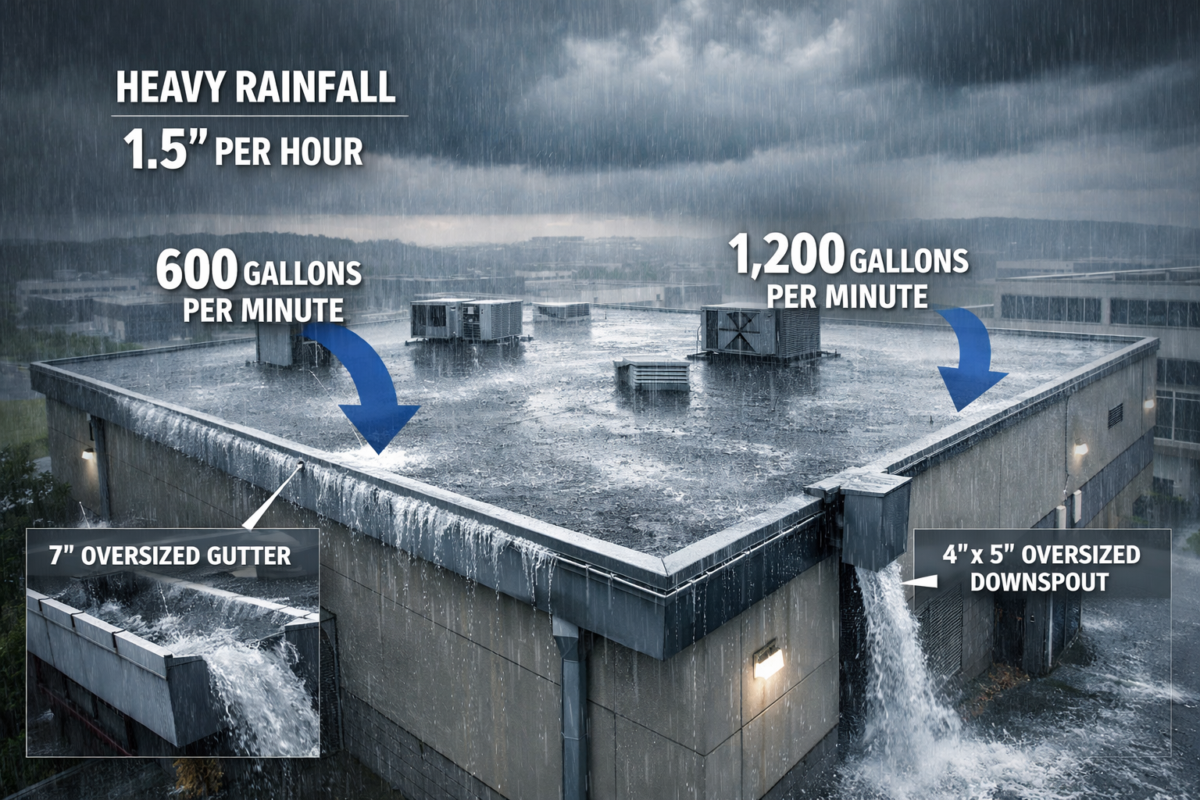
Here’s a useful way to think about scale. At just 1 inch of rain per hour, approximately 96 square feet of roof area generates 1 gallon of runoff per minute. A commercial roof covering 50,000 square feet produces over 500 gallons per minute under the same conditions. Standard gutters aren’t designed to move that kind of volume without overflowing.
Washington’s adopted Uniform Plumbing Code (Chapter 51-56 WAC, effective March 15, 2024) makes this a code requirement. Roof drainage components must be sized using the maximum projected roof area and the local rainfall rate. Secondary drainage systems are generally sized for double the local rainfall rate. So even the state’s legal framework assumes that standard sizing won’t always be enough.
Overflow from undersized gutters damages fascia, saturates wall assemblies, and creates foundation-adjacent water problems. For a commercial building, replacement costs are significantly higher than for a residential one.
Architectural Factors That Demand Customization
Roof area is one part of the equation, but geometry matters just as much. A multi-level building with interior roof valleys, parapet walls, and expansion joints doesn’t drain the way a simple sloped roof does. Runoff concentrates in specific zones, and each zone may require its own engineered gutter run rather than a standard continuous profile.
Slope also changes the math. A pitched commercial roof uses design area factors, not just flat plan area, because the angle increases the effective drainage load. Two buildings with identical footprints can end up needing different commercial gutters and downspouts because one concentrates water into a few high-load sections while the other distributes it more evenly.
Unusual eave details add another layer. Some commercial buildings have minimal overhangs, exposed structural elements, or architectural features that leave no clean surface for standard gutter attachment. Historic buildings often need custom profiles to match existing details or conceal gutters within the building envelope. In those cases, you’re sizing for water volume and fabricating to fit a specific building.
Hydrological Demands of Washington Commercial Properties
Washington cities such as Seattle, Spokane, and Walla Walla use a design rainfall rate of 1 inch per hour as a baseline. That figure feeds directly into the sizing formula: engineers calculate the flow rate for each drainage zone using the roof area, runoff coefficient, and rainfall intensity.
Depending on the building, that calculation can push required gutter widths to 8, 10, or even 12 inches. NOAA Atlas 14 precipitation data is used to pull site-specific intensity figures, which means a building in the foothills may face different requirements than one in a drier inland location.
Low-slope and flat commercial roofs create a different set of demands entirely. These buildings often rely on internal drains or scuppers rather than perimeter gutters, and when perimeter drainage is used, it typically takes the form of box or parapet gutters integrated into the building’s parapet wall.
These systems must be fabricated to exact dimensions. There’s no off-the-shelf version that accounts for a specific parapet depth or drain location.
Custom Components: Downspouts, Scuppers, and Expansion
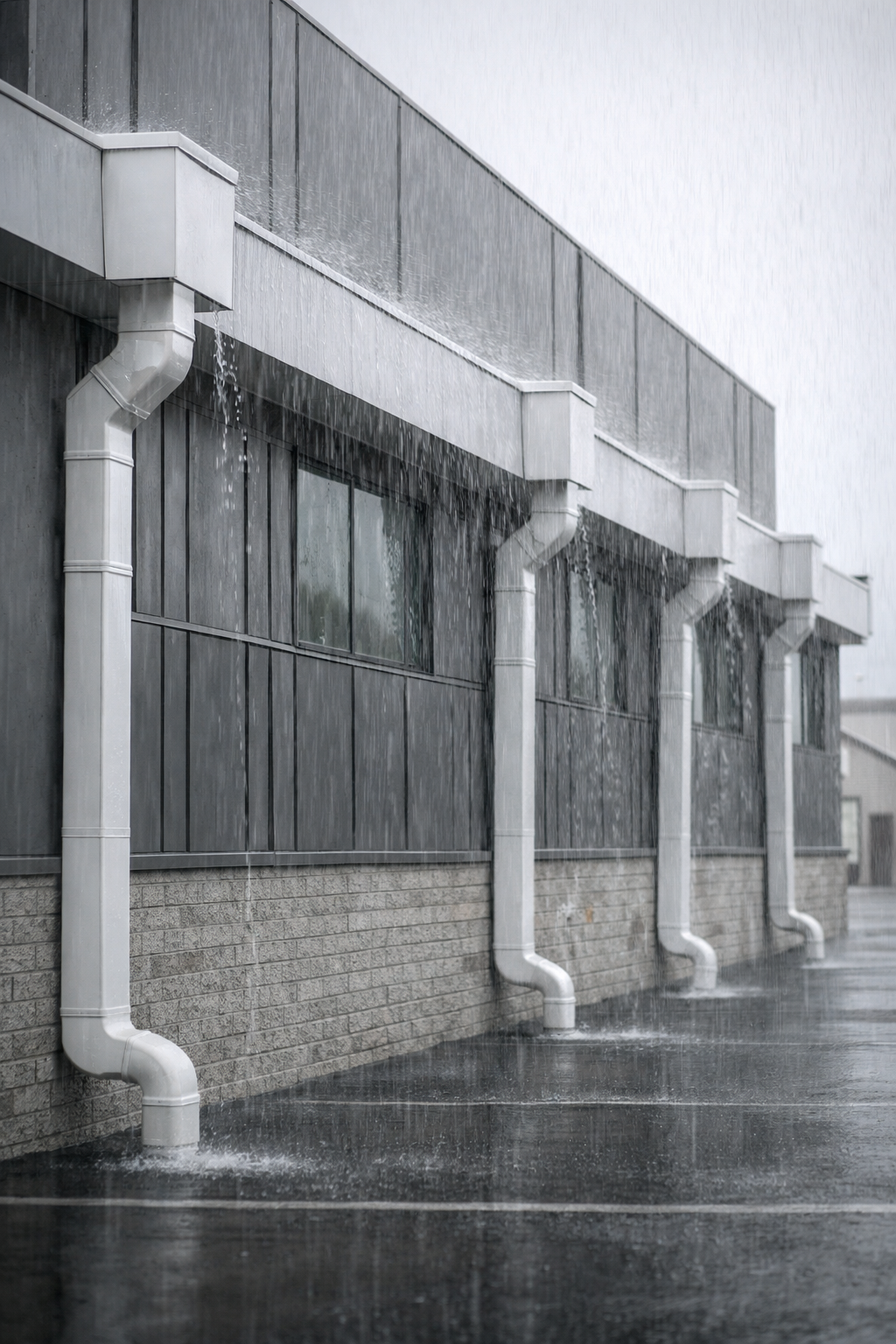
A custom gutter only works if everything downstream is sized to match. SMACNA’s commercial drainage guidelines make it clear that downspout capacity should equal gutter outlet capacity, so a large gutter paired with undersized downspouts will still overflow. On large commercial systems, that means downspouts may need to be 4×5 or 5×6 inches in rectangular profile, sometimes larger.
Long roof edges create additional constraints. SMACNA identifies 50 feet as a practical maximum gutter length served by a single downspout. Longer runs require more downspouts, expansion joints at thermal movement points, and conductor heads to prevent vacuum buildup.
When Standard Gutter Installation Becomes Industrial Gutter Installation
Most commercial gutter installation involves engineered sizing, not just larger versions of residential profiles. But some buildings move beyond even that. Manufacturing plants and large warehouses may face high debris loads, high concentrations of roof drain points, or structural requirements that demand industrial gutters, heavy-gauge steel or aluminum systems with structural supports rather than fascia-mounted designs.
Material selection can also change. High-corrosion environments, whether from coastal exposure or industrial emissions, may require stainless steel or coated aluminum in gauges that simply aren’t stocked. Some gutter runs must support maintenance access or accommodate snow loads, which pushes the design into load-bearing fabrication territory.
Low-slope commercial roofs with parapet gutter conditions require systems tested to standards such as ANSI/SPRI GT-1, which are specifically developed for edge drainage on low-slope assemblies. When a building’s drainage path also intersects with municipal stormwater controls, the design must account for compliance at a site level, not just at the roofline.
The Cost of Getting Sizing Wrong
Overflow stains and pooling near the foundation are the obvious signs, but they’re just the beginning. Water that backs up repeatedly works into fascia, wall assemblies, and the roof membrane itself.
Gutters that are too small also clog faster, which means more frequent cleaning and higher ongoing maintenance costs. Roofing warranties can also be affected, and in some Washington jurisdictions, chronic drainage failures can draw attention from stormwater compliance.
The gutter system is rarely the biggest line item on a commercial property, but undersizing it tends to cost far more than sizing it correctly from the start.
Invest in Gutters Engineered for Your Building
No two commercial properties are identical, and their gutter systems shouldn’t be either. Custom sizing isn’t about extravagance. It’s about matching capacity to reality.
Washington’s climate, combined with the state’s adopted code framework, provides contractors and property owners with clear guidance on what constitutes proper drainage. When a building’s roof geometry, area, or structure pushes beyond what standard profiles can handle, commercial gutter installation needs to reflect that.
At Gutter Empire, we design and install custom commercial gutters sized to your property’s actual drainage needs. Give us a call at (971) 777-9899, click here for a free estimate, or reach out through our contact form to schedule a consultation.
Key Takeaways
- Standard gutter sizes (5–6 inches) are often insufficient for large commercial roofs that generate hundreds of gallons per minute of runoff.¹
- At just 1 inch of rainfall per hour, 96 square feet of roof produces 1 gallon per minute, meaning large buildings require significantly higher-capacity systems.¹
- Washington code requires drainage systems to be sized using roof area and local rainfall intensity, with secondary systems often designed for even higher capacity.²
- NOAA Atlas 14 data provides site-specific rainfall intensity values, which engineers use to determine appropriate gutter sizing.³
- Roof geometry—such as valleys, parapet walls, and multi-level designs—can concentrate water flow into specific areas, requiring custom gutter runs rather than standard continuous systems.
- Commercial guidelines recommend limiting gutter runs and ensuring proper outlet capacity, with downspouts sized to match gutter flow and often spaced every ~50 feet.⁴
- Custom systems may include box gutters, oversized downspouts (4×5 or larger), expansion joints, and conductor heads to manage thermal movement and high flow rates.
- Undersized systems lead to overflow, structural damage, increased maintenance, and potential code or compliance issues.
Citations
- Berger Building Products – Gutter and downspout sizing calculations https://bergerbp.com/wp-content/uploads/2022/07/propergutterdownspoutsizing.pdf
- Washington Administrative Code – Storm drainage requirements https://app.leg.wa.gov/wac/default.aspx?cite=51-56&full=true
- NOAA Atlas 14 – Precipitation Frequency Data Server https://hdsc.nws.noaa.gov/pfds/
- SMACNA Drainage Sizing Calculator & Guidelines https://apps.smacna.org/dsgcal/