Gutter Installation & Gutter Guards in Vancouver, WA | Gutter Empire

Categories
Blog Gutter Cleaning Gutter Repair

Signs Gutter Cleaning Needs to Happen More Often in Washington

Washington looks peaceful from the outside. Tall evergreens, wet air, and rain that feels constant but almost normal once you live here long enough.

The problem is that gutters experience all of that up close. Needles fall every day, leaves show up even when it is not “fall,” and rain keeps coming back before things ever dry out.

That is why basic twice-a-year gutter cleaning often misses the reality for many Washington homes. The environment works against a neat seasonal schedule.

In this article, we will walk through the signs that your gutters need attention sooner and why changing your cleaning frequency can help protect your home before overflow and water damage start to accumulate.


Quick Answer

Washington’s wet climate, heavy tree canopy, and recurring atmospheric river storms cause gutters to clog faster than standard twice-per-year schedules account for. This guide explains the real-world signs that gutters need more frequent cleaning — including overflow, visible debris, sagging, and pest activity — and why increasing cleaning frequency helps prevent fascia rot, foundation saturation, and system failure.


Key Warning Signs Your Gutters Need Cleaning Sooner

Some gutter problems announce themselves loudly. Others start quietly, then become obvious during the wrong storm. Washington has enough rain that you do not get many second chances.

The Evidence of Overflow

The clearest warning sign is also the most immediate.

You stand outside during a storm and see water spilling over the edge instead of moving through the downspouts. That is not just messy. It means flow is already restricted.

Even small clogs matter here because Washington rain events can be intense. A few inches of rainfall on a roof can create several thousand gallons of runoff. Gutters have one job: carry that water away instead of letting it pour straight down the exterior.

And storms in Washington do not always arrive gently. In December 2025, parts of the Olympics and Cascades received more than 10 inches of precipitation in a few days, with multiple rivers reaching record flood levels.

When rain comes like that, clogged gutters are no longer a minor issue. Overflow can hit fascia boards, soak siding, and send water right to the foundation in real time.

At that point, calling a local gutter cleaning service near you becomes mandatory.

Visible Debris Accumulation

Sometimes you notice the problem before the storm even starts.

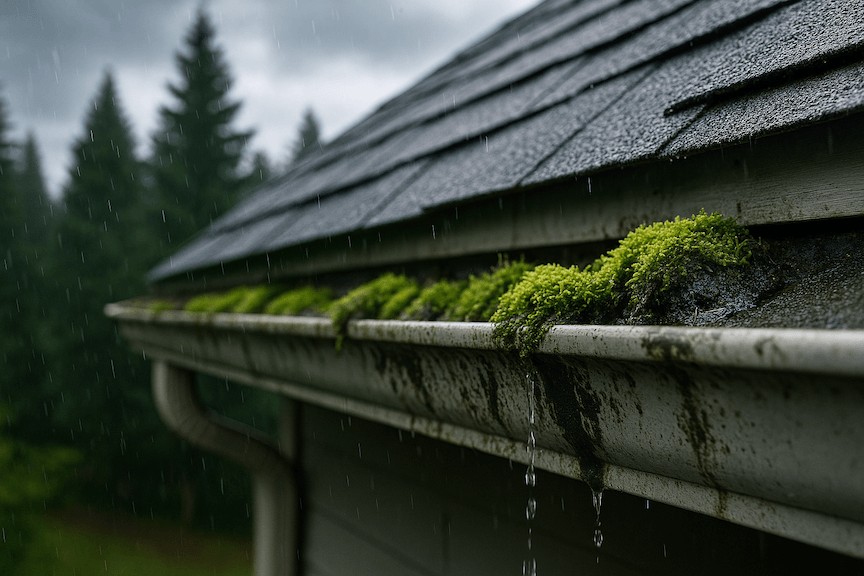
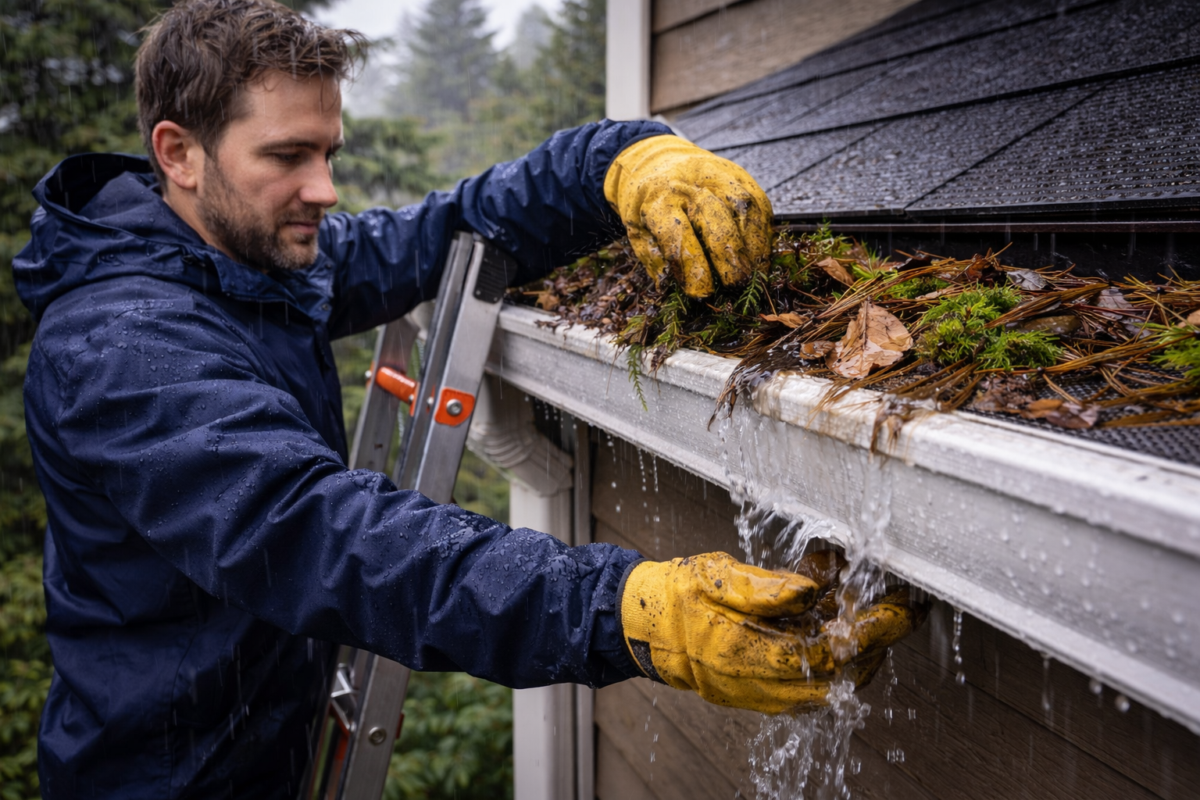
Maybe you look up, and the gutters appear full. Dark clumps sit along the channel. You might even spot little bits of moss or plant growth.

That buildup tells you debris has been sitting long enough to hold moisture. And in Washington, moisture sticks around. Organic material does not just dry out and disappear. It compacts.

Tree cover is one reason this happens faster here. Urban Washington averages about 33% tree canopy. That means debris falls constantly, not once a year. Pine needles, leaves, cones, twigs. The gutters keep collecting.

Over time, that weight strains the system, and the trapped moisture accelerates rust and wood rot. If you keep seeing this, you likely need more frequent gutter cleaning services, not just a seasonal check.

Sagging or Pull-Away

Gutters should stay tight to the roofline. When sections start bending downward, something is weighing them down.

Wet debris gets heavy fast. Rain turns loose leaves and needles into dense-packed material. That weight stresses the hangers and fasteners until they fail.

When gutters sag, the risk is not just performance. Detachment can happen. Repairs become expensive. This is where gutter cleaning and repair often overlap, because cleaning alone may not address the strain damage that has already begun.

Animal or Pest Activity

One sign that people do not always connect with gutters is the presence of pests. Birds start hovering near the eaves. Rodents find nesting material. Insects show up more around the roof edge.
Clogged gutters create the perfect setup: wet organic debris, shelter, and sometimes standing water. That attracts pests because it gives them both cover and resources.

The urgency is that pests can worsen blockages, damage roof edges, and sometimes enter attic spaces. In a climate where gutters stay damp for long stretches, these nesting conditions last longer than they would in a dry region.

Why the “Standard” Schedule Fails in Washington

Washington is not a place where gutters only fill up in October. The environment does not work that way.

Heavy Tree Canopy Coverage

The tree canopy alone changes everything. Urban areas average about 33% coverage, and Washington is more than half forested overall. Many homes are subject to constant debris fall.

Needles do not politely wait for autumn. They drop year-round. Leaves show up in waves. The gutters refill continuously, making a twice-a-year routine feel unrealistic for many neighborhoods.

Frequent and Heavy Rainfall

Heavy rainfall washes debris into corners and downspouts. It also compresses existing clogs into thick, heavy masses.

During the December 2025 atmospheric river cycle, over 100,000 residents were placed under evacuation notice in some areas. Even if your home never floods like that, the lesson still matters. When rain intensifies, gutters must function perfectly. Even partial clogs can fail.

That is why homeowners dealing with recurring clogged gutters often need cleaning more often than the calendar suggests.

Moss and Algae Growth

Washington’s climate encourages moss growth on roofs and algae buildup inside gutters. That adds another layer of clogging material, in addition to leaves and needles.

Moss does not flush easily. It builds slowly, stays wet, and thickens into a stubborn organic blockage. It is another reason many homeowners choose professional gutter cleaning over treating it as an occasional chore.

The Proactive Benefits of Increased Cleaning Frequency

Cleaning more often is not about perfection. It is about avoiding preventable damage.

Prevents Costly Water Damage

Roof runoff must be directed away from the home to prevent soil saturation, mold growth, and durability issues. In Washington, water keeps coming back. If overflow happens repeatedly, fascia rot and foundation erosion become much more likely.

Preserves Your Gutter System

Frequent cleaning reduces strain on seams, hangers, and attachment points. It prevents the heavy buildup that causes sagging and pull-away. That preservation matters because replacing gutters costs far more than maintaining them.

Saves Money Long-Term

Extra cleanings cost less than major repairs. Fixing fascia boards, correcting drainage issues, or addressing water intrusion can add up quickly. Staying ahead with a regular gutter cleaning service near you usually saves money over time.

Take Control of Your Gutter Schedule

Recognizing these signs is the first step in adapting your home maintenance to Washington’s demanding environment. When you clean more often, you stop reacting to overflow and start protecting your home before damage becomes routine.

If you are seeing repeated buildup, overflow, or sagging, we can help. Contact Gutter Empire LLC to schedule professional gutter cleaning and repair services. Call us at (971) 777-9899, click here for a free estimate, or contact us to ensure your gutters are ready for the next stretch of rain.


Key Takeaways

  • Washington’s heavy rainfall and atmospheric river events can overwhelm partially clogged gutters very quickly.
  • Overflow during storms is the clearest sign that gutter cleaning is already overdue.
  • Visible debris, moss, and plant growth indicate moisture-retaining buildup that accelerates gutter and fascia damage.
  • Sagging or pull-away sections often mean wet debris weight is stressing brackets and fasteners.
  • Pest activity near the roofline often signals clogged, organic-filled gutters.
  • Due to high tree canopy coverage and year-round needle drop, many Washington homes need cleaning more than twice per year.
  • More frequent cleaning helps prevent water damage, preserve gutter structure, and reduce long-term repair costs.

Citations

  1. CW3E Atmospheric River Summary – December 2025 precipitation and atmospheric river impacts in the Pacific Northwest
    https://cw3e.ucsd.edu/wp-content/uploads/2025/12/23Dec2025_Summary/23Dec2025_Summary.pdf
  2. Washington State Department of Natural Resources — Tree canopy and statewide tree coverage metrics
    https://dnr.wa.gov/news/2025/american-forests-washington-state-department-natural-resources-launch-statewide-tree-equity-score
  3. University of Washington Climate Impacts Group — December 8–11, 2025 heavy rainfall and flooding historical context
    https://climate.uw.edu/2026/01/13/december-8-11-2025-heavy-rainfall-and-flooding-historical-context-and-a-note-on-snow-drought/
Categories
Blog Gutter Guard Installation Gutter Guards

Why Heavy Spring Debris Makes Gutter Guards Essential in Washington

In Washington, spring does not ease into the calendar quietly. It follows months of wind, steady rain, and trees that shed more than just autumn leaves.

Heavy debris here means wet pine needles, gritty roof sediment, moss fragments, and the occasional fir cone, all pressed together by moisture. That mix explains why homeowners keep asking whether gutter guards work under conditions like these.

The short answer is yes, but only under the right circumstances. Gutter guards can handle heavy debris effectively when the design matches local conditions, and the work is done correctly.

This article breaks down how different guard styles respond to buildup and water flow. It explains what to expect from gutter guard installation. It also covers when installing gutter guards reduces clogging and when maintenance or system upgrades still matter.

AI Overview Summary

Washington’s wet springs and heavy debris create ideal conditions for gutter clogs and overflow. This article explains how pine needles, moss, and roof sediment affect gutter performance, compares gutter guard designs, and outlines when gutter guards reduce maintenance—and when underlying gutter issues must be addressed first.

What is “Heavy Debris” in the Washington Context?

Heavy debris in Washington behaves differently from the dry leaves people picture in milder climates. Pine needles absorb water, swell, and interlock with one another. Moss breaks into fine, spongy clumps that cling to metal surfaces rather than sliding off.

Add in roof grit and shingle sediment that wash down with every storm, and you get a dense mix that fills the small spaces between larger debris. Over time, that material compresses into flat, stubborn mats that sit in place and block water rather than moving along with it.

The real challenge is not weight by itself. It is persistence. Long, wet stretches keep debris saturated, making it heavier, stickier, and harder to dislodge.

In a state that has seen dozens of billion-dollar weather disasters since 1980, including repeated severe storms and flooding, gutters operate under constant pressure. Any gutter protection system here has a demanding job: keep this debris out while still allowing heavy, fast-moving rain to enter the system without backing up.

How Gutter Guard Designs Tackle Heavy Buildup

Not all gutter guards respond the same way when debris builds up. The design determines whether water keeps flowing or backs up during the first hard rain.

Surface Tension (Reverse Curve) Guards

Surface-tension, or reverse-curve, guards rely on water hugging a curved hood and dropping into the gutter. In clean conditions, this can work. With Washington’s fine debris, problems show up faster.
Pine needles and grit can slip through the edges, and moss often settles on top of the hood. Once that happens, water can overshoot the opening during heavy rain.

Mesh & Screen Guards

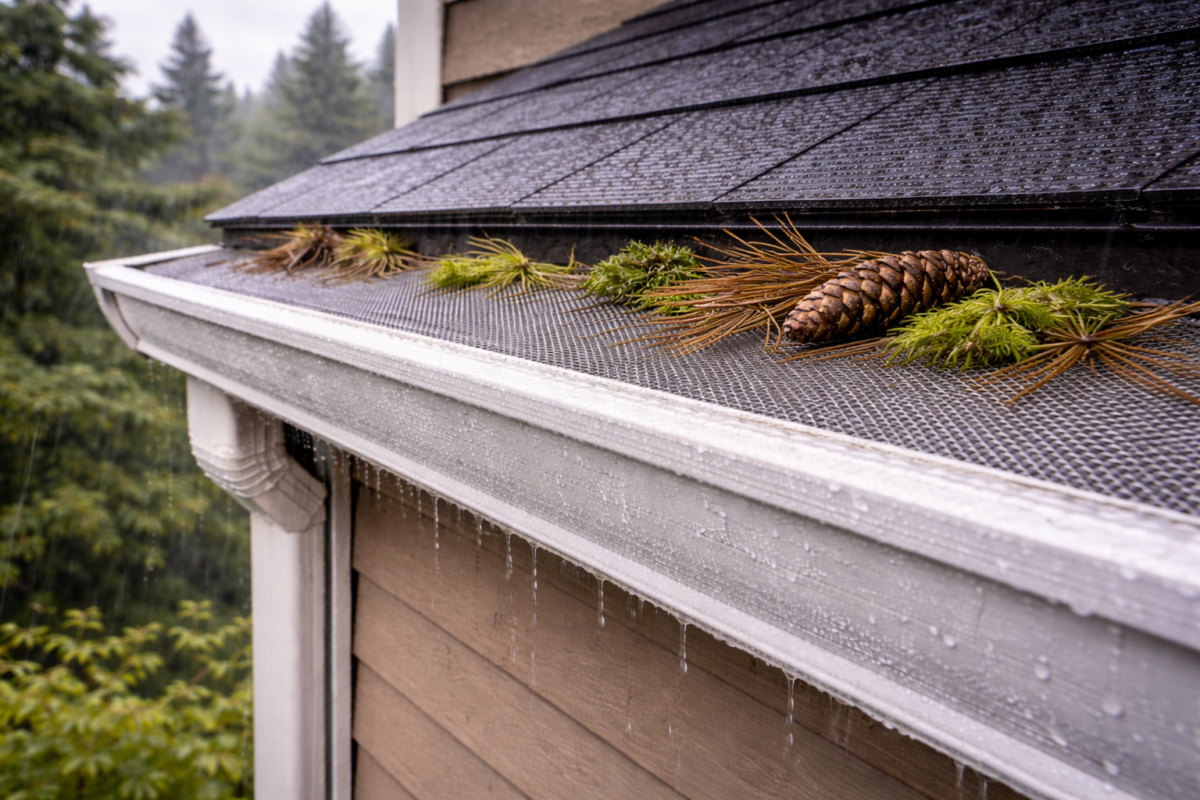
Mesh and screen guards vary widely. Large-hole screens struggle here because pine needles pass through or bridge the openings. Micro-mesh designs use much finer openings, which block needles and moss fragments more reliably while still allowing water through.

Independent consumer testing has shown that performance varies significantly across products, and this is where the difference usually appears. In Washington’s debris mix, micro-mesh guards tend to hold up best when properly installed.

Brush & Foam Inserts

Brush and foam inserts sound appealing, but heavy debris exposes their weaknesses. These systems sit inside the gutter and trap material that you cannot see. Instead of preventing clogs, they often hide them. Cleaning becomes harder, not easier, especially after a wet winter.

Overall, micro-mesh designs offer the most consistent defense against Washington’s fine, clingy debris, as long as the rest of the system supports proper flow.

Limitations and Realistic Expectations

Even the best system has limits. No gutter guard is completely maintenance-free. Wind-blown soil, roof grit, and moss spores can accumulate on guards over time. That buildup usually needs an occasional rinse or inspection, especially after storms.

Storm frequency matters here. In 2024 alone, the United States saw 27 separate billion-dollar weather and climate disasters. In 2025, severe storms again dominated losses, with more than 20 billion-dollar events nationwide. These numbers explain why gutters fail when margins are thin. During wind-driven rain, water volume and debris arrive together.

Installation quality also sets expectations. If a guard sits unevenly or lacks proper pitch, it becomes a debris catch. In that case, the guard itself causes overflow.

Guards also cannot compensate for undersized, sagging, or damaged gutters. When the base system fails, guards become a secondary fix at best.

The Keys to Success With Heavy Debris

Even the best gutter guard design can fail if the surrounding conditions are ignored. In Washington, long wet seasons and heavy debris mean performance depends as much on evaluation and installation as on the product itself.

Professional Assessment is Critical

A professional assessment looks beyond the product. Roof pitch, valley runoff, tree species, and the condition of existing gutters all influence whether a guard will succeed.

For many homeowners, the real question is simple: Do gutter guards work on this house, with this debris? In Washington, matching the guard to the debris profile matters as much as the guard itself.

Quality of Installation Matters

Properly installing gutter guards means more than attaching panels. Installers must eliminate gaps, maintain a consistent pitch, and secure the system to withstand wind and debris loads. With severe storms now a regular part of the national weather pattern, fastening and alignment affect long-term performance, not just appearance.

Complement With Gutter Health

Guards support healthy gutters, but they do not replace them. If sections sag or outlets back up, debris will still cause trouble. Before gutter guard installation, gutters need a solid attachment and clear drainage paths. When those conditions exist, guards help reduce buildup rather than conceal structural issues.

Choose the Right Defense for Your Debris

Gutter guards can make a real difference for Washington homeowners dealing with heavy debris, but they are not a universal fix. Success depends on pairing an engineered micro-mesh solution with the right conditions and installing it with care. When the system matches the environment, gutters shift from a constant maintenance worry to a reliable part of the home’s exterior.

If you are weighing whether gutter guards work for your property or planning gutter guard installation before spring storms arrive, we can help. At Gutter Empire, LLC, we take a system-first approach and install solutions built for Washington conditions. Contact us at (971) 777-9899, click here for a free estimate, or visit our contact form to schedule a consultation.


Key Takeaways

  • Washington’s debris is uniquely challenging.
    Wet pine needles, moss fragments, and roof grit compress into dense mats that block water flow during long rain cycles, especially in spring.
  • Design matters more than branding.
    Micro-mesh gutter guards consistently outperform surface-tension, screen, and insert styles in Washington’s fine, clingy debris conditions.
  • No gutter guard is maintenance-free.
    Even high-quality systems require periodic inspection and rinsing due to storm frequency and persistent moisture.
  • Installation quality determines success.
    Improper pitch, loose fastening, or gaps can cause guards themselves to trigger overflow during heavy rain.
  • Gutter guards only work on healthy systems.
    Sagging, undersized, or poorly draining gutters must be corrected before guards can provide real protection.

Citations

  • NOAA National Centers for Environmental Information — U.S. Billion-Dollar Weather & Climate Disasters
    https://www.ncei.noaa.gov/access/billions/
  • Climate Central — 2025 in Review: Extreme Weather Trends
    https://www.climatecentral.org/climate-matters/2025-in-review
Categories
Blog Gutter Cleaning Gutter Repair

From Moss to Mold: Unique Gutter Problems in Washington State

You know the Washington look. Lush evergreens with vibrant moss coating old stone walls, and rich, earthy smells after rain. It looks beautiful until it’s on your house. The same damp and cool climate that keeps Washington State evergreen is also a major enemy to one of your home’s first lines of defense: your gutters.

While other states worry about autumn leaves, Washington homeowners have to contend with a different menace: the slow and steady siege by moss, mold, and moisture that does more than just clog their gutters. These three silently compromise your roofing, rot your fascia boards, and even affect the air quality in your house.

Why Washington State’s Climate Is a Perfect Storm for Gutter Problems

The main issue is hardly the volume of rain, but its consistency. The constant drizzle creates a damp environment that is ideal for organic material. For instance, pine needles from cedars and firs fall throughout the year, creating a dense, net-like debris that holds moisture and serves as the perfect breeding ground for moss spores floating in the breeze and the mold that thrives in shady areas.

This combination not only blocks water flow from the roof, but also creates a heavy and wet living mass in your gutter system that accelerates wear and tear in ways dry leaves never could. This is why standard gutter maintenance strategies used in drier states often fall short here, since our unique environment demands a more vigilant approach to gutter maintenance that Washington homeowners can rely on.

Several key factors make our climate particularly harsh on gutters:

  • Year-Round Debris: Evergreens like cedars and firs drop needles constantly, creating a dense, net-like clog.
  • Moisture Retention: This debris acts like a sponge, holding water against your gutter surfaces.Spore Proliferation: The damp, shaded environment is perfect for moss and mold spores to take root and grow.
  • The Silent Gutter Killer: Moss in Gutters and Its Consequences

When moss establishes itself in gutters, it acts as a sponge, absorbing and retaining water. This water retention and growth add weight that strains gutter hangers and pulls entire gutter systems down. However, the damage goes deeper, as the moss in gutters attaches itself using tiny rhizoids that dig into gritty surfaces. This traps moisture directly against gutter surfaces, leading to rust and corrosion in steel gutters, as well as the degradation of aluminum gutters over time.

Most dangerously, moss in gutters prevents proper drainage, which means that water overflows and cascades down exterior walls, soaking the wooden fascia boards that hold the gutters. This is where a simple cleaning job can quickly escalate into a need for full fascia board replacement, which Washington residents would want to avoid.

When Mold in Gutters Becomes a Health Hazard

Wherever moss thrives, mold is never far behind. As such, your gutters could become a thriving ecosystem of various molds and mildews. Therefore, while cleaning visible growth from your gutters is important, you should also be concerned about what you can’t see.

The spores from mold in gutters can easily enter your house through small cracks, attic vents, and windows. Once inside, they degrade your indoor air quality and pose larger health risks, especially for people with allergies, asthma, and other respiratory illnesses. The musty smell that sometimes permeates a house after it rains can often be traced back to a moldy and overflowing gutter system by the window.

This makes addressing mold in gutter systems an essential part of home maintenance, not only for the structure but also for health reasons.

The Domino Effect: From Gutter Clogs to Fascia Board Rot

This is where the true cost of neglect adds up, a destructive sequence any experienced gutter repair Washington professional knows all too well.

It starts with the clog, then debris and mold build up, trapping water. As the water overflows, it spills onto the fascia boards. In Washington’s damp climate, constantly wet fascia boards do not dry out. Instead, the water soaks in, the wood softens, and the rotting begins. You never see it until the paint starts bubbling or you notice the wood crumbling. By then, the structural integrity of the wood has already been compromised.

Rotting fascia boards can no longer securely hold the weight of the gutters, especially when clogged with water and moss. The result is sagging gutters that fall off if not cleaned or repaired immediately. Typically, gutter problems are discovered during cleaning, and what began as a simple $200 gutter maintenance task now becomes a $2000 project that includes full gutter reinstallation and the necessary fascia board replacement that Washington homeowners dread.

How Professional Washington Gutter Cleaning Fights Back

You can always handle gutter cleaning yourself, but dealing with slippery, moss-laden gutters is a risky venture. Furthermore, professional Washington gutter cleaning involves more than just dirt and debris removal; it also includes inspecting the gutters and fascia and implementing protective measures.

Expert technicians do not just scoop the muck. They also power-flush downspouts to restore flow, inspect for signs of rot and corrosion, and even fix loose fasteners that you would miss. They also apply mild treatments to slow down moss and mold regrowth, thus giving your gutters a fighting chance.

For many homeowners, this proactive service is the difference between affordable routine maintenance and a desperate call for emergency gutter repair services in Washington during a storm.

Do Not Let the Northwest Green Take Over Your Home

As your gutters work tirelessly all year round to defend your home against Washington’s relentless weather, ignoring the unique threats posed by moss and mold isn’t just neglect, but a gamble with your home’s structural health and your own. What seems to be a simple issue today can quickly spiral into extensive and expensive repairs in the long run.

Luckily, at Gutter Empire, your local expert in gutter cleaning, repair, and maintenance in Washington, we understand that the solution is consistent and knowledgeable care. We know how the Washington climate attacks your gutter system, and since we confront this kind of damage daily, we have the expertise to both fix and prevent it.

As local gutter cleaning services near you, we are ready to help keep your home safe and dry. We handle everything from comprehensive Washington gutter cleaning that eliminates moss at its source to precise gutter repair residents trust to address damage early.

Don’t wait for water stains to appear on your ceilings or for your gutters to fall away from the roof. Schedule your professional gutter evaluation with Gutter Empire today by calling (971) 777-9899 or contacting us online for a free estimate. We’ll show you how a proactive gutter maintenance approach can save you thousands and deliver peace of mind all year long.


Key Takeaways

  1. Washington’s damp, evergreen climate fuels the growth of moss and mold, which clogs gutters, traps moisture, and accelerates wear and tear.
  2. Moss acts like a sponge in gutters, adding weight, causing corrosion, and leading to fascia board rot and sagging gutter systems.
  3. Mold growth in gutters is more than just a structural issue; it poses a significant health risk, as spores can enter homes and compromise indoor air quality.
  4. Neglected clogs trigger a domino effect, escalating from small maintenance needs to expensive fascia replacement and full gutter reinstallation.
  5. Professional Washington gutter cleaning services go beyond debris removal, providing comprehensive inspections, downspout flushing, minor repairs, and moss prevention treatments.

Last updated: October 2025