Gutter Installation & Gutter Guards in Vancouver, WA | Gutter Empire

Categories
Blog Commercial Gutters Gutter Installation

How Commercial Gutters and Downspouts Differ from Residential Systems

A warehouse and a ranch house both deal with rain, but the way they manage it is not even close to the same. From the ground, gutters can look similar due to metal channels at the roof edge and downspouts running vertically along the wall. But once you step back and look at roof size, slope, and rainfall load, the differences become clear quickly.

Commercial gutters and downspouts are not simply larger versions of residential systems. They are designed around higher water volume, broader roof spans, and stricter performance standards. That shift changes sizing, materials, attachment, and even maintenance strategy.

Below are the structural and operational differences between commercial drainage and residential gutter installation.


Quick Answer Summary

Commercial gutters and downspouts differ from residential systems in size, materials, and engineering requirements. While homes typically use 5-inch gutters and smaller downspouts designed for pitched roofs, commercial buildings rely on larger box gutters, heavier metals, and engineered drainage calculations to manage higher water volume from flat or low-slope roofs. These systems often integrate directly with the roof structure and underground drainage to prevent ponding and structural water damage.


Size and Capacity

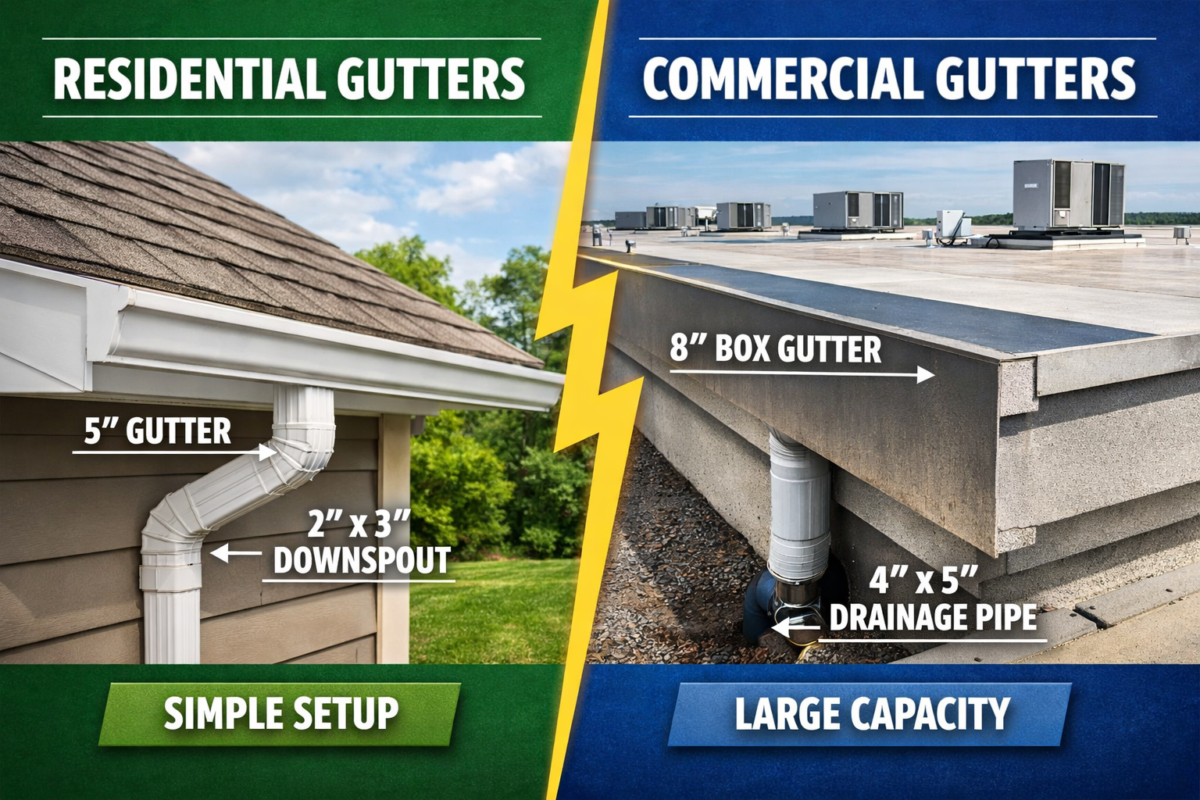
Most homes rely on 5-inch K-style gutters paired with 2×3-inch downspouts. Industry guidance confirms 5-inch systems remain the standard for residential use, with 6-inch options used when roof planes get larger or steeper. That setup works because pitched residential roofs shed water in relatively narrow channels.

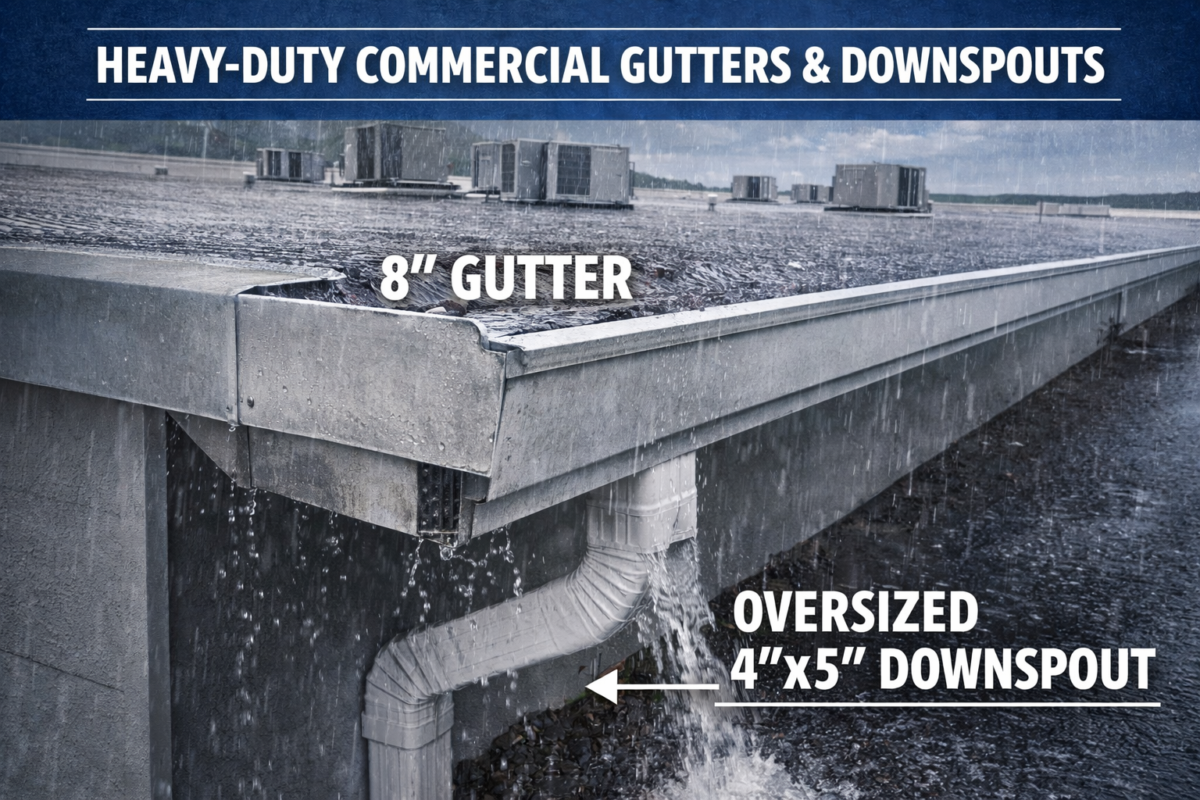
Commercial profiles commonly range from 6 to 8 inches wide. Some systems exceed that. Some manufacturers list 7-inch and 8-inch configurations in 24-gauge steel, built specifically for high-capacity runoff. Flat and low-slope roofs collect water differently. Instead of dispersing runoff quickly, they channel it across large, uninterrupted surfaces. That concentration demands deeper troughs and larger outlets.

Downspouts follow the same logic. Residential downspouts are often 2×3 or 3×4 inches. In commercial settings, 4×5 inches or larger becomes common. Codes reinforce why. Plumbing standards require vertical leaders to be sized according to the calculated flow rate. Some code tables indicate that 8-inch leaders can carry more than 1,200 gallons per minute under design conditions. That number alone illustrates how commercial drainage operates on another scale.

Material Selection

Material choice reflects expected stress. Residential systems typically use lightweight aluminum or vinyl. They resist rust, come in multiple colors, and remain affordable. For most homes, they perform well.

In contrast, commercial gutters often rely on 24-gauge galvanized steel or heavier architectural aluminum. GAF manuals repeatedly specify 24-gauge steel for box systems because thicker metal resists deformation under sustained loads. The material is not chosen for appearance. It is chosen because water weight adds up quickly on large roofs.

Commercial downspouts are typically fabricated from thicker metal to prevent bending or distortion along tall runs. Protective coatings guard against constant exposure to the elements. In hail-prone regions, replacing lighter aluminum components with stronger steel improves durability.
Severe convective storms cost insurers roughly $46 billion in just the first three quarters of 2025. Exterior components absorb that stress first.

System Design

Most of the time, residential drainage systems are installed along the edge of the roof. Gutters attach to fascia boards, and downspouts discharge at grade. The system operates independently of the roof structure.

With commercial box gutters, the design changes. Many commercial buildings conceal gutters within parapet walls or integrate them directly into the roofing assembly. Commercial roofing manuals detail overflow scuppers, flange dimensions, fastening schedules, and membrane tie-ins. Drainage becomes part of the roof system rather than an add-on.

Downspouts in commercial systems often connect to internal drains or below-grade piping. Designers do not rely on surface splash blocks. They coordinate with site drainage infrastructure. Designers must size drains, gutters, and overflow pathways together. That redundancy reduces the risk of ponding on low-slope roofs.

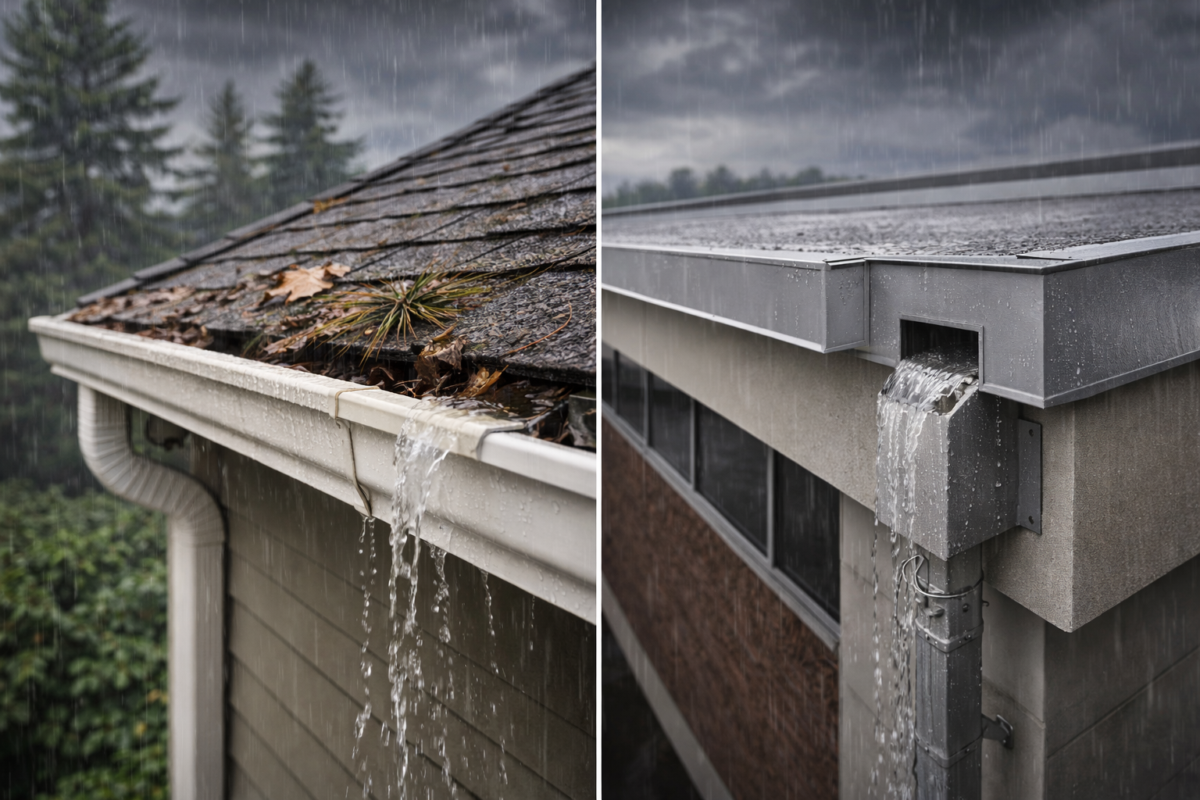
Residential systems rarely require overflow scuppers or secondary drains. Commercial roofs, however, assume blockages will happen and plan for controlled discharge when they do.

Downspout Engineering

On homes, downspouts serve a straightforward purpose: to move water away from the foundation. Discharge should be directed at least five feet away from the structure in certain soil conditions. That is often accomplished with simple extensions.

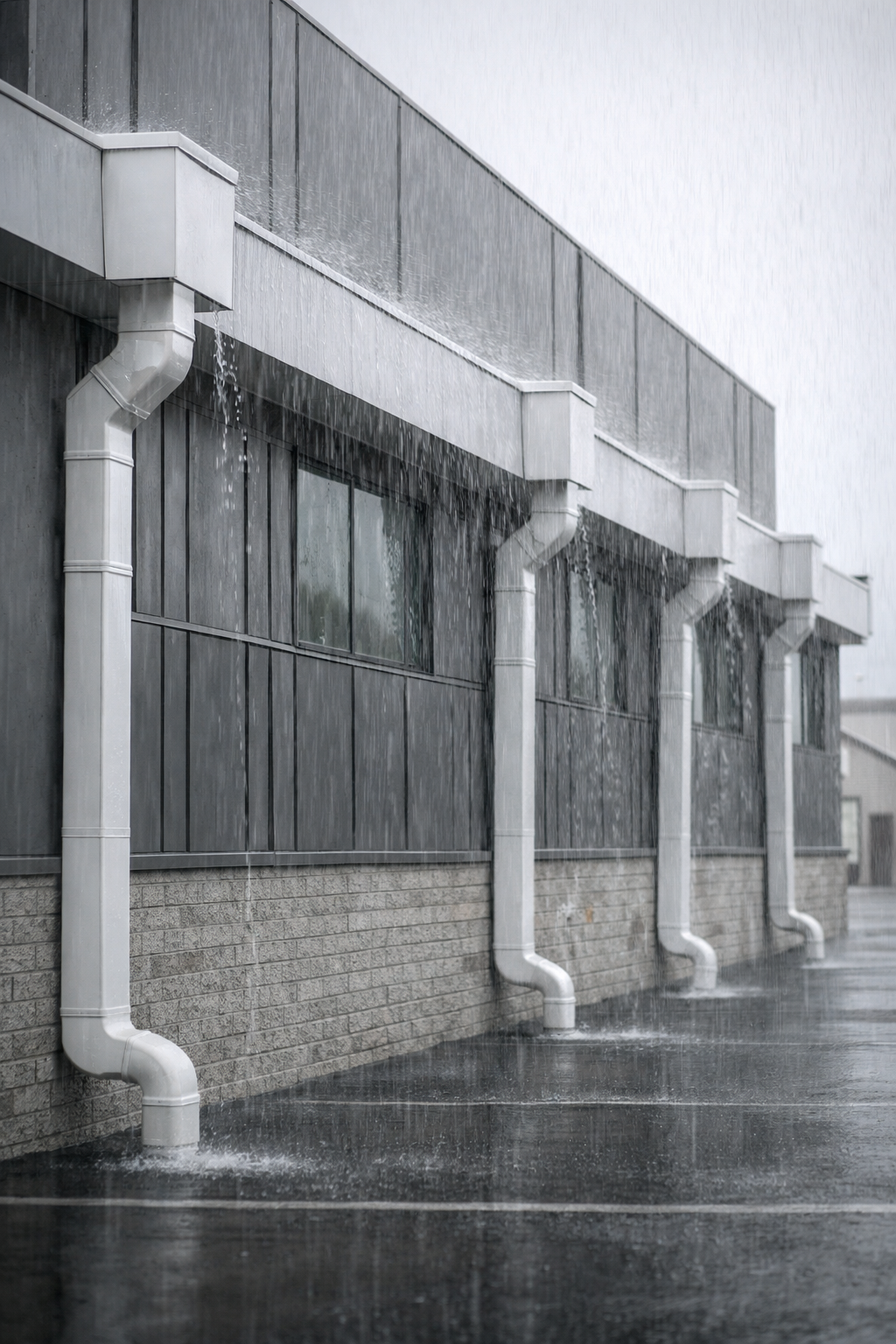
Commercial downspouts operate differently. Designers calculate spacing intervals to maintain water velocity and prevent backup. The diameter is selected to match the roof drainage modeling. Placement is strategic, not aesthetic.

Many commercial gutters and downspouts connect directly to underground stormwater systems. Those connections require watertight transitions and compatibility with municipal drainage standards. That integration rarely appears in residential work.

Structural Considerations

Attachment methods reveal another difference. Residential gutters hang from fascia boards using spikes, ferrules, or hidden hangers. The strength of the trim largely supports the load.

Commercial systems anchor into structural components. Heavy-duty brackets, cleats, and straps attach to framing rather than to decorative fascia. The goal is to distribute weight and withstand long-term stress.

Thermal expansion also plays a larger role in commercial settings. Long gutter runs require expansion joints positioned at calculated intervals. Without them, metal can buckle. That level of planning seldom appears in typical residential projects.

Winds as low as 60 mph can damage older roofing systems. Once the roof covering fails, the equivalent of nine bathtubs of water can enter a structure for every inch of rainfall. Drainage performance becomes part of broader envelope protection.

Installation Complexity

Residential gutter installation usually happens quickly. Small crews complete most homes in a day using ladders and basic tools.

Commercial work uses lift equipment, fall protection, and engineered layouts. Multiple trades, like roofers, contractors, and engineers, stay involved. Gutters and downspouts must connect cleanly to roofing membranes and structural framing so the drainage system performs without unexpected weak points.

Maintenance Demands and Service Intervals

Homeowners typically clean gutters twice a year. FEMA recommends routine maintenance to prevent overflow and water intrusion. That schedule works for most houses.

Commercial systems require scheduled professional inspections. Large roof surfaces collect debris across wide spans. You can’t always see the internal drainage paths from the ground. Maintenance may involve lifts and trained crews. Documentation can also support warranty compliance.

As weather patterns intensify, consistent inspection becomes more important. NOAA data show that Washington has experienced dozens of billion-dollar disasters since 1980, with the frequency increasing in recent years. Prolonged rainfall puts sustained pressure on drainage systems.

Choose the System That Matches Your Building’s Demands

A residential roof and a commercial roof might sit under the same storm cloud, yet the systems protecting them work in very different ways. Homes rely on gutters meant for smaller roof areas and quick runoff, while commercial gutters and downspouts deal with broader surfaces, heavier flow, and drainage that ties directly into the building’s structure. That contrast matters when you are choosing what will safeguard your property.

Commercial drainage is its own discipline, shaped by roof layout, load expectations, and the intensity of local weather. Knowing this helps owners pick systems that match real-world demands rather than assumptions.

We at Gutter Empire LLC design solutions for that level of performance. Call (971) 777-9899, click here for a free estimate, or use our contact form to schedule your consultation.


Key Takeaways

  • Residential homes usually use 5-inch gutters with 2×3-inch downspouts, while commercial buildings often require 6- to 8-inch gutters and larger leaders to handle greater runoff volumes.¹
  • Flat or low-slope commercial roofs collect water differently, requiring engineered drainage calculations and overflow pathways to prevent ponding.²
  • Commercial gutters frequently use 24-gauge galvanized steel or heavy architectural aluminum to withstand higher loads and environmental stress.²
  • Downspouts in commercial systems may connect to internal drains or underground stormwater infrastructure, unlike residential splash-block drainage.
  • Severe convective storms caused approximately $46 billion in insured losses in the first three quarters of 2025, increasing the importance of durable exterior drainage systems.³
  • Commercial installations require structural anchoring, expansion joints, and coordinated roofing integration, while residential systems typically attach to fascia boards.²
  • Maintenance schedules differ significantly: homes often require biannual cleaning, while commercial buildings need professional inspections and documented maintenance programs.

Citations

  1. NYC Administrative Code – Storm drainage sizing and leader capacity guidance
    https://codelibrary.amlegal.com/codes/newyorkcity/latest/NYCadmin/0-0-0-163449
  2. GAF EverGuard Roofing Manual – Commercial box gutter materials and system design requirements
    https://www.gaf.com/en-us/document-library/documents/manuals/everguard-tpo-pvc-induction-welded-attachment-roofing-system-manual-version-2.0.pdf
  3. Insurance Information Institute – Severe convective storm losses and industry impact
    https://insuranceindustryblog.iii.org/category/severe-convective-storm/
Categories
Blog Gutter Installation

The Operational Difference Between Residential and Commercial Gutter Installation

A strip mall and a craftsman bungalow might sit on the same street, but the gutters protecting them live in completely different worlds. Homes rely on smaller systems that handle predictable runoff from pitched roofs. Larger buildings need something far more engineered.

In a place like Washington, where the past few years have brought more intense storms and heavier rainfall, the gap becomes even clearer. NOAA reported 27 separate billion-dollar disasters across the U.S. in 2024, and Washington has seen its own trend shift, averaging more than two major events per year between 2020 and 2024.

As storms grow more aggressive, the difference between typical home gutters and commercial gutter installation becomes more than a construction detail. It becomes a resilience strategy.


Quick Answer

Residential and commercial gutter systems differ in size, materials, design, and engineering requirements. Homes use smaller gutters on pitched roofs with predictable runoff, while commercial buildings require larger, engineered systems to handle flat roofs, higher water volume, and code-mandated overflow protection. In regions with heavier storms, properly sized commercial drainage with scuppers, internal drains, and oversized downspouts is essential to prevent structural damage.


Scale and Capacity

The size and shape of the roof drive how a gutter system works, and residential roofs keep things simple. Most homes rely on 5-inch K-style gutters paired with smaller downspouts, usually 2×3 inches. Water naturally sheds off pitched surfaces, and the drainage paths are easy to predict.

That changes quickly once you step onto a commercial property. Flat and low-slope roofs move water slowly, allowing runoff to accumulate in large volumes before reaching a drain. To move that much water fast, buildings often need 6- to 8-inch commercial gutters, along with oversized 4×5-inch leaders or even larger configurations.

Commercial drainage also depends on calculations rather than assumptions. Engineers use formulas such as Q = CIA, which account for roof area, rainfall intensity, and runoff behavior.

The 2024 International Plumbing Code relies on that approach, requiring gutters and internal drains to be sized based on actual flow rates. The code also requires overflow routes, such as scuppers or secondary drains, so that trapped water cannot build up enough weight to strain the roof.

Material Selection

Residential Materials

Residential gutters tend to favor materials that keep installation fast and affordable. Aluminum is the go-to because it resists rust, comes in a wide range of colors, and can be shaped onsite.

PVC sometimes appears on smaller homes or detached structures that do not face heavy loads. These materials do their job well enough when roofs are smaller and storms are moderate.

Commercial Materials

Commercial buildings ask for something stronger. Heavier-gauge galvanized steel, copper, and zinc appear far more often, mostly because they hold shape under stress. A long run of metal across a flat roof takes hits from wind uplift, debris, and temperature swings. Thicker metals absorb that abuse without warping or tearing at seams.

Weather matters. Aluminum performs well near the coast thanks to its salt resistance, but steel becomes the practical pick in colder areas with constant freeze-thaw cycles.

IBHS research between 2024 and 2026 continues to reinforce that durable exterior systems correlate with fewer storm-related claims, and that connection applies just as much to gutters as to roofing and siding.

Design and Configuration

Residential Design

Most homes follow familiar patterns. Water slides down a pitched surface toward the eaves, where K-style or half-round gutters catch the flow and direct it into small downspouts. The system is visible, easy to access, and usually mounted directly to fascia boards. It works because the roof shape naturally guides water where it needs to go.

Commercial Design

Commercial buildings go a different way. Because flat or low-slope roofs don’t move water very quickly, designers use internal drains, parapet walls, and small roof slopes to direct runoff where it needs to go.

These roofs often rely on commercial box gutters that sit inside the roof edge rather than hanging off it. Those box channels move large amounts of water toward conductor heads or into commercial gutters and downspouts engineered for higher capacity.

Overflow scuppers become part of the architecture, not an afterthought. Codes back this up by requiring emergency pathways whenever a roof’s perimeter can trap water.

Installation Complexity

Residential crews can usually complete a job in a day. They bring a forming machine, shape seamless aluminum to fit, and mount the system using ladders and portable tools. It is straightforward and predictable.

Commercial jobs require a different level of preparation. Crews often operate lifts, scaffolding, roof-access platforms, or boom equipment to reach parapet edges and drainage points.

OSHA standards require fall protection at six feet or more, which changes the rhythm of the work. Installation involves staging zones, tenant coordination, and more careful task sequencing. Even fabrication behaves differently.

While homes rely on seamless gutters formed onsite, commercial properties often need custom-built components sized from engineered drawings, including conductor heads, oversized downspouts, and welded or riveted box sections made to fit roof geometry with precision.

Codes, Compliance, and Warranty Considerations

Homeowners rarely deal with complex code reviews for gutters. Local guidelines matter, but they are often minimal. Commercial projects face a much heavier regulatory load:

  • International Code Council standards set the baseline for sizing drainage, determining where overflow routes must be, and how stormwater integrates with the rest of the site.
  • Municipal stormwater rules sometimes require engineering submittals and inspections.
  • SMACNA guidelines influence fabrication details, and that documentation is often shared with inspectors or building managers.

Warranties also work differently. Commercial systems may carry longer coverage, but those warranties usually require scheduled maintenance to stay active. Missed inspections can void protection, which makes maintenance part of the installation story rather than an add-on.

Maintenance Demands and Lifespan Expectations

Most homes get by with seasonal cleanings and occasional repairs. When leaves build up or downspouts clog, a simple cleaning brings the system back into shape.

The stakes rise sharply on commercial buildings. Flat roofs collect debris more easily, and internal drains must stay clear, or water begins to pond. Overflow scuppers and emergency routes need routine checks so they work when storms hit.

Durability reflects these demands. A well-installed commercial system built from steel, copper, or heavy-gauge aluminum can last far longer than typical residential setups. The combination of stronger materials, engineered design, and controlled expansion gives them a longer usable life even under harsh weather cycles.

Choose the System Engineered for Your Building

Every structure needs a drainage system designed for its own challenges. Homes lean toward aesthetics and routine performance, while larger buildings rely on engineering that handles enormous water volume, deeper structural integration, and the realities of long-term wear.

As storms become more intense in Washington, the value of choosing the right system becomes even more obvious. Misjudging capacity or materials now can turn into serious water damage later.

If you are unsure which approach fits your property, we can help you sort through the details and choose with confidence. Gutter Empire is ready to help. Reach us at (971) 777-9899, click here for a free estimate, or contact us to schedule your commercial or residential gutter consultation.


Key Takeaways

  • The U.S. recorded 27 billion-dollar weather disasters in 2024, increasing the need for higher-capacity storm drainage systems.¹
  • Residential gutters typically use 5-inch profiles with 2×3-inch downspouts, while commercial buildings often require 6–8-inch gutters and 4×5-inch leaders to manage larger roof areas.
  • Flat and low-slope commercial roofs hold water longer, requiring engineered flow calculations and controlled drainage pathways.²
  • The International Plumbing Code requires overflow scuppers or secondary drains so trapped water cannot overload the roof.²
  • Commercial systems use heavier-gauge steel, copper, or zinc to withstand wind, debris, and thermal movement.
  • Durable exterior systems are linked to fewer storm-related insurance claims, reinforcing the value of robust materials and design.³
  • Commercial installation involves lifts, fall protection, staging, and engineered fabrication, making it more complex than residential work.
  • Ongoing maintenance is essential for commercial drainage because internal drains and flat roofs are more prone to ponding.²
  • Properly designed commercial gutter systems can achieve longer lifespans due to stronger materials and engineered expansion control.³

Citations

  1. NOAA / Climate.gov – Billion-dollar weather disasters data
    https://www.climate.gov/news-features/blogs/beyond-data/2024-active-year-us-billion-dollar-weather-and-climate-disasters
  2. International Plumbing Code – Storm drainage sizing and overflow requirements
    https://codes.iccsafe.org/s/PHXPC2024P1/chapter-11-storm-drainage/PHXPC2024P1-Ch11-Sec1106.6
  3. Insurance Institute for Business & Home Safety – Thunderstorm-ready and durable exterior systems guidance
    https://ibhs.org/ibhs-news-releases/ibhs-releases-thunderstorm-ready-guidance/