
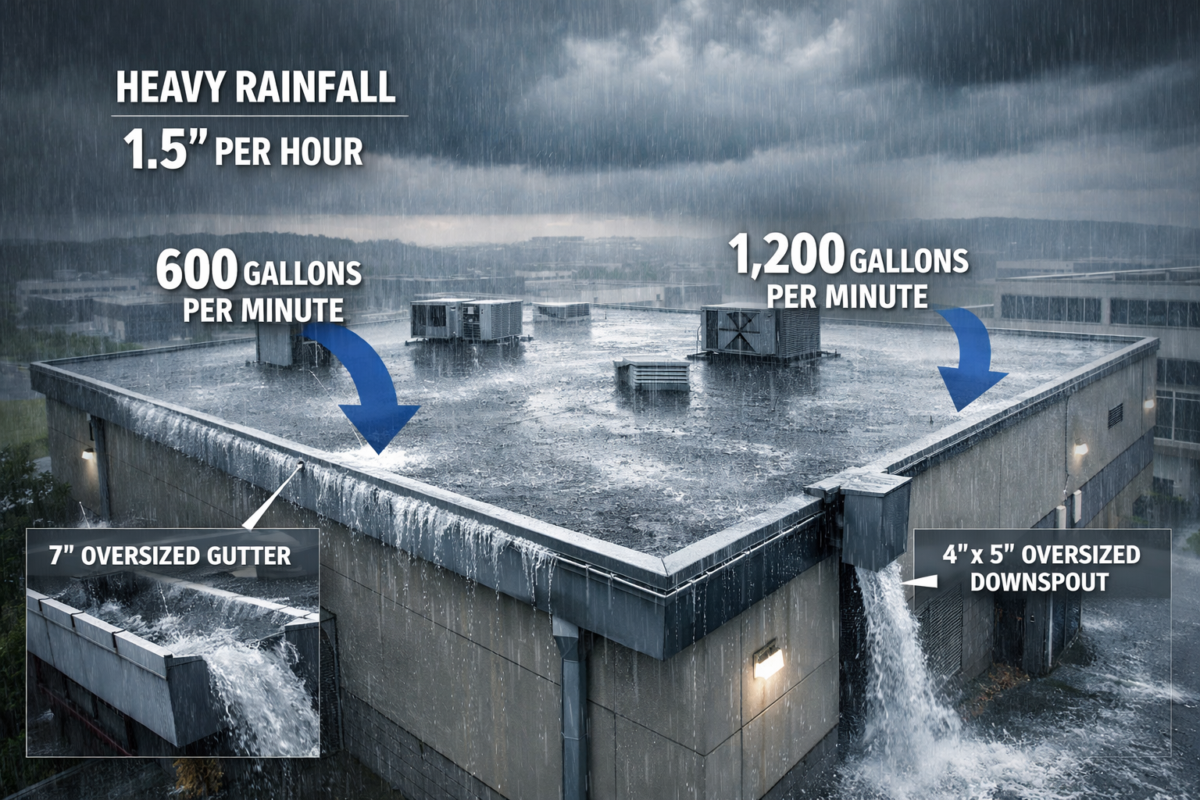
In Washington, a light drizzle and an atmospheric river event place vastly different demands on a building’s drainage system, yet both must be managed by the same gutters. In December 2025, a potent atmospheric river delivered so much rain that several locations in western Washington received more than 10 inches over 72 hours. According to NASA, Seattle-Tacoma International Airport set a daily rainfall record of 1.6 inches on December 10. For commercial property owners, that kind of intensity is the scenario engineers are supposed to design for.
Rainfall intensity is one of the key engineering factors in commercial gutter sizing, working alongside drainage area, roof geometry, and outlet capacity. They dictate everything from gutter width to downspout capacity for proper commercial gutter installation. Here’s how rainfall data drives gutter design, why bigger isn’t always better without engineering behind it, and why getting sizes right is what protects commercial buildings from water damage.
Quick Answer Summary
Rainfall intensity directly determines the size and capacity required for commercial gutters and downspouts. In high-rain regions like Washington, heavy storms and atmospheric river events can produce large volumes of runoff in a short time. Engineers use rainfall intensity data, roof area, and flow calculations to size gutters and downspouts so they can handle peak storm conditions without overflowing. Properly sized systems prevent water damage, while undersized systems can quickly fail during high-intensity rain events.
The Engineering Formula (Q=ciA) Explained
Commercial gutter sizing starts with math. Engineers use what’s called the rational method: Q is the target flow rate the system must handle; c is a surface runoff factor; i is the local rainfall intensity; and A is the total drainage area the gutter serves.
For commercial roofs with impervious membrane surfaces, a runoff coefficient of 1.0 is the conservative standard, meaning 100% of rainfall becomes runoff with nowhere to go except into the gutter system. On a flat commercial roof, that’s often a very accurate assumption.
Roof geometry adds complexity on top of that. Multi-gable roofs and internal valleys concentrate water at specific points along the roofline, meaning one gutter section might handle far more water than a basic square-footage calculation would suggest. A 20,000-square-foot warehouse roof behaves completely differently from that of a multi-peak structure with the same footprint.
How Rainfall Intensity Dictates Gutter Dimensions
Here’s where the engineering math translates into actual hardware. At low to moderate rainfall intensities, a 5-inch gutter might hold its own. Stepping up to a 6-inch profile provides a substantial increase in capacity, which is why 6-inch systems are often the starting point for true commercial gutter sizes.
Seven-inch and 8-inch gutters are typically found on hotels, warehouses, medical centers, and other large commercial facilities where roof drainage areas run into the tens of thousands of square feet. Stepping up from a 5-inch to a 6-inch gutter provides a substantial increase in capacity, but the exact gain depends on the gutter profile, outlet spacing, roof geometry, and rainfall assumptions used in the design.
Commercial box gutters, with their rectangular profile, are well-suited to high-intensity applications. Their geometry optimizes hydraulic performance while maintaining a clean exterior line.
At the far end of the scale, industrial gutters with deep-profile engineering are built for flow rates that would overwhelm multiple standard systems combined. The physics are consistent across all of them: Profile depth and width directly determine how much water a system can move before it overflows.
Downspouts: The Critical Capacity Partner
A gutter perfectly sized for an atmospheric river means nothing if the downspouts can’t clear water fast enough. Commercial gutters and downspouts are engineered as a matched system, and the downspout is usually where undersized installations fail first.
It takes 96.15 square feet of roof surface to generate 1 gallon per minute of flow at 1 inch per hour of rain, which means downspout capacity must be calculated based on both roof area and local rainfall intensity. A 6-inch gutter typically requires 3”×4” downspouts, while a 5-inch gutter pairs with 2”×3” downspouts. For large commercial systems, 4”×5” downspouts are standard. The math scales fast on a 30,000-square-foot commercial roof.
Many commercial drainage systems also connect underground to municipal stormwater infrastructure. Those connections require watertight transitions and correct sizing at every junction, not just at the gutter, but all the way through to the drain. Any mismatch along that path becomes a failure point during peak flow.
Design Features for High-Intensity Rainfall
Sizing is the foundation, but several design details separate a properly installed commercial system from one that will fail within a few years.
Thermal movement is frequently overlooked. Aluminum expands and contracts meaningfully across Washington’s seasonal temperature range. Long commercial gutter runs need expansion provisions to accommodate thermal movement. The exact spacing depends on the material, run length, and the governing standard or manufacturer guidance.
Bracket spacing also matters. Heavy-duty commercial systems require closer fascia bracket spacing to support the weight of water during peak-flow events.
A gutter running full during a high-intensity storm carries a significant structural load, as inadequate brackets cause sagging, leading to pooling and accelerating corrosion. Heavy-gauge aluminum, galvanized steel, and copper each provide the structural rigidity that large-scale Washington installations demand.
Code Compliance and Professional Standards
Washington commercial gutter design must align with the locally adopted building, plumbing, and stormwater codes and, where applicable, use site-specific rainfall data from NOAA Atlas 14.
NOAA’s Precipitation Frequency Data Server delivers Atlas 14 precipitation-frequency estimates for any U.S. location, providing engineers with the site-specific rainfall-intensity data needed to accurately size drainage systems. Reputable contractors use Atlas 14 alongside local intensity-duration-frequency curves to ensure systems are built for the storms Washington produces, including those short-duration, high-intensity bursts that atmospheric rivers deliver.
In high-density areas, Seattle-area stormwater regulations often require gutters to integrate with rain gardens, catch basins, or other stormwater management features. Industrial gutters serving large impervious surfaces can also trigger additional permitting requirements depending on the jurisdiction.
Engineer Your Commercial Property for Washington’s Real Rainfall
A commercial gutter system isn’t something you pick off a shelf. It’s an engineered solution calibrated to your building’s specific roof area and Washington’s documented rainfall intensity. Getting the size right means the difference between controlled drainage and catastrophic overflow during the next atmospheric river event. An undersized system doesn’t just overflow. It can direct water against foundations, saturate soils, and cause damage that takes months and significant money to repair.
At Gutter Empire, we design and install commercial gutters and downspouts sized for Washington’s actual rainfall. Call us at (971) 777-9899, click here for a free estimate, or reach us through our contact form to schedule your commercial consultation today.
Key Takeaways
- Rainfall intensity is a primary factor in commercial gutter sizing and is calculated using formulas like Q = ciA, which account for runoff, rainfall rate, and roof area.
- Atmospheric river events can deliver extreme rainfall over short periods, placing significant stress on commercial drainage systems.¹
- Commercial gutters typically range from 6 to 8 inches or larger, depending on roof size and rainfall intensity.
- Downspouts must match gutter capacity; undersized downspouts are often the first point of system failure during heavy rain.²
- At 1 inch of rainfall per hour, approximately 96.15 square feet of roof generates 1 gallon per minute of runoff, illustrating how quickly flow rates increase on large buildings.²
- NOAA Atlas 14 data provides location-specific rainfall intensity values used by engineers to design compliant drainage systems.³
- Proper design includes not only sizing, but also thermal expansion allowances, bracket spacing, and integration with stormwater infrastructure.
- Undersized systems can lead to overflow, foundation damage, and soil saturation, especially during high-intensity storm events.
Citations
- NASA Earth Observatory – Atmospheric river rainfall impacts in the Pacific Northwest
https://science.nasa.gov/earth/earth-observatory/pacific-moisture-drenches-the-u-s-northwest/ - Berger Building Products – Gutter and downspout sizing calculations
https://bergerbp.com/wp-content/uploads/2022/07/propergutterdownspoutsizing.pdf - NOAA Atlas 14 – Precipitation Frequency Data Server
https://hdsc.nws.noaa.gov/pfds/