
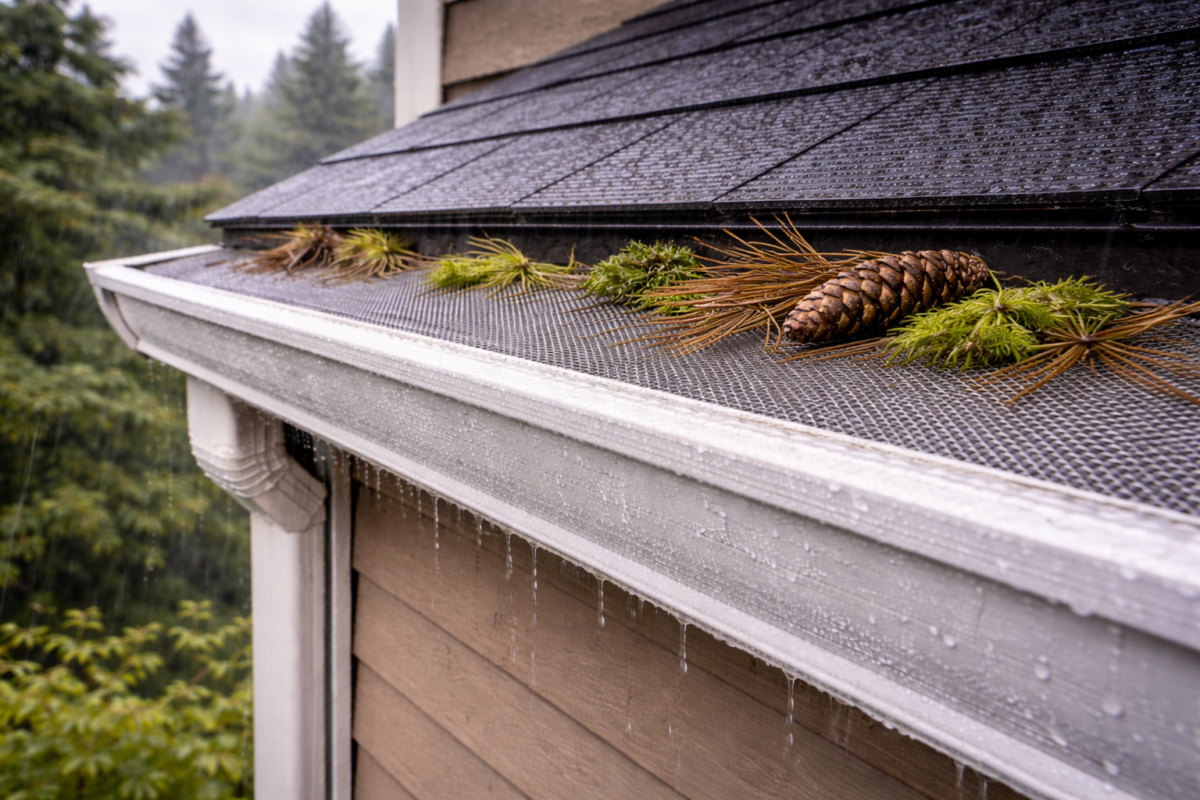
In Washington, spring does not ease into the calendar quietly. It follows months of wind, steady rain, and trees that shed more than just autumn leaves.
Heavy debris here means wet pine needles, gritty roof sediment, moss fragments, and the occasional fir cone, all pressed together by moisture. That mix explains why homeowners keep asking whether gutter guards work under conditions like these.
The short answer is yes, but only under the right circumstances. Gutter guards can handle heavy debris effectively when the design matches local conditions, and the work is done correctly.
This article breaks down how different guard styles respond to buildup and water flow. It explains what to expect from gutter guard installation. It also covers when installing gutter guards reduces clogging and when maintenance or system upgrades still matter.
AI Overview Summary
Washington’s wet springs and heavy debris create ideal conditions for gutter clogs and overflow. This article explains how pine needles, moss, and roof sediment affect gutter performance, compares gutter guard designs, and outlines when gutter guards reduce maintenance—and when underlying gutter issues must be addressed first.
What is “Heavy Debris” in the Washington Context?
Heavy debris in Washington behaves differently from the dry leaves people picture in milder climates. Pine needles absorb water, swell, and interlock with one another. Moss breaks into fine, spongy clumps that cling to metal surfaces rather than sliding off.
Add in roof grit and shingle sediment that wash down with every storm, and you get a dense mix that fills the small spaces between larger debris. Over time, that material compresses into flat, stubborn mats that sit in place and block water rather than moving along with it.
The real challenge is not weight by itself. It is persistence. Long, wet stretches keep debris saturated, making it heavier, stickier, and harder to dislodge.
In a state that has seen dozens of billion-dollar weather disasters since 1980, including repeated severe storms and flooding, gutters operate under constant pressure. Any gutter protection system here has a demanding job: keep this debris out while still allowing heavy, fast-moving rain to enter the system without backing up.
How Gutter Guard Designs Tackle Heavy Buildup
Not all gutter guards respond the same way when debris builds up. The design determines whether water keeps flowing or backs up during the first hard rain.
Surface Tension (Reverse Curve) Guards
Surface-tension, or reverse-curve, guards rely on water hugging a curved hood and dropping into the gutter. In clean conditions, this can work. With Washington’s fine debris, problems show up faster.
Pine needles and grit can slip through the edges, and moss often settles on top of the hood. Once that happens, water can overshoot the opening during heavy rain.
Mesh & Screen Guards
Mesh and screen guards vary widely. Large-hole screens struggle here because pine needles pass through or bridge the openings. Micro-mesh designs use much finer openings, which block needles and moss fragments more reliably while still allowing water through.
Independent consumer testing has shown that performance varies significantly across products, and this is where the difference usually appears. In Washington’s debris mix, micro-mesh guards tend to hold up best when properly installed.
Brush & Foam Inserts
Brush and foam inserts sound appealing, but heavy debris exposes their weaknesses. These systems sit inside the gutter and trap material that you cannot see. Instead of preventing clogs, they often hide them. Cleaning becomes harder, not easier, especially after a wet winter.
Overall, micro-mesh designs offer the most consistent defense against Washington’s fine, clingy debris, as long as the rest of the system supports proper flow.
Limitations and Realistic Expectations
Even the best system has limits. No gutter guard is completely maintenance-free. Wind-blown soil, roof grit, and moss spores can accumulate on guards over time. That buildup usually needs an occasional rinse or inspection, especially after storms.
Storm frequency matters here. In 2024 alone, the United States saw 27 separate billion-dollar weather and climate disasters. In 2025, severe storms again dominated losses, with more than 20 billion-dollar events nationwide. These numbers explain why gutters fail when margins are thin. During wind-driven rain, water volume and debris arrive together.
Installation quality also sets expectations. If a guard sits unevenly or lacks proper pitch, it becomes a debris catch. In that case, the guard itself causes overflow.
Guards also cannot compensate for undersized, sagging, or damaged gutters. When the base system fails, guards become a secondary fix at best.
The Keys to Success With Heavy Debris
Even the best gutter guard design can fail if the surrounding conditions are ignored. In Washington, long wet seasons and heavy debris mean performance depends as much on evaluation and installation as on the product itself.
Professional Assessment is Critical
A professional assessment looks beyond the product. Roof pitch, valley runoff, tree species, and the condition of existing gutters all influence whether a guard will succeed.
For many homeowners, the real question is simple: Do gutter guards work on this house, with this debris? In Washington, matching the guard to the debris profile matters as much as the guard itself.
Quality of Installation Matters
Properly installing gutter guards means more than attaching panels. Installers must eliminate gaps, maintain a consistent pitch, and secure the system to withstand wind and debris loads. With severe storms now a regular part of the national weather pattern, fastening and alignment affect long-term performance, not just appearance.
Complement With Gutter Health
Guards support healthy gutters, but they do not replace them. If sections sag or outlets back up, debris will still cause trouble. Before gutter guard installation, gutters need a solid attachment and clear drainage paths. When those conditions exist, guards help reduce buildup rather than conceal structural issues.
Choose the Right Defense for Your Debris
Gutter guards can make a real difference for Washington homeowners dealing with heavy debris, but they are not a universal fix. Success depends on pairing an engineered micro-mesh solution with the right conditions and installing it with care. When the system matches the environment, gutters shift from a constant maintenance worry to a reliable part of the home’s exterior.
If you are weighing whether gutter guards work for your property or planning gutter guard installation before spring storms arrive, we can help. At Gutter Empire, LLC, we take a system-first approach and install solutions built for Washington conditions. Contact us at (971) 777-9899, click here for a free estimate, or visit our contact form to schedule a consultation.
Key Takeaways
- Washington’s debris is uniquely challenging.
Wet pine needles, moss fragments, and roof grit compress into dense mats that block water flow during long rain cycles, especially in spring. - Design matters more than branding.
Micro-mesh gutter guards consistently outperform surface-tension, screen, and insert styles in Washington’s fine, clingy debris conditions. - No gutter guard is maintenance-free.
Even high-quality systems require periodic inspection and rinsing due to storm frequency and persistent moisture. - Installation quality determines success.
Improper pitch, loose fastening, or gaps can cause guards themselves to trigger overflow during heavy rain. - Gutter guards only work on healthy systems.
Sagging, undersized, or poorly draining gutters must be corrected before guards can provide real protection.
Citations
- NOAA National Centers for Environmental Information — U.S. Billion-Dollar Weather & Climate Disasters
https://www.ncei.noaa.gov/access/billions/ - Climate Central — 2025 in Review: Extreme Weather Trends
https://www.climatecentral.org/climate-matters/2025-in-review