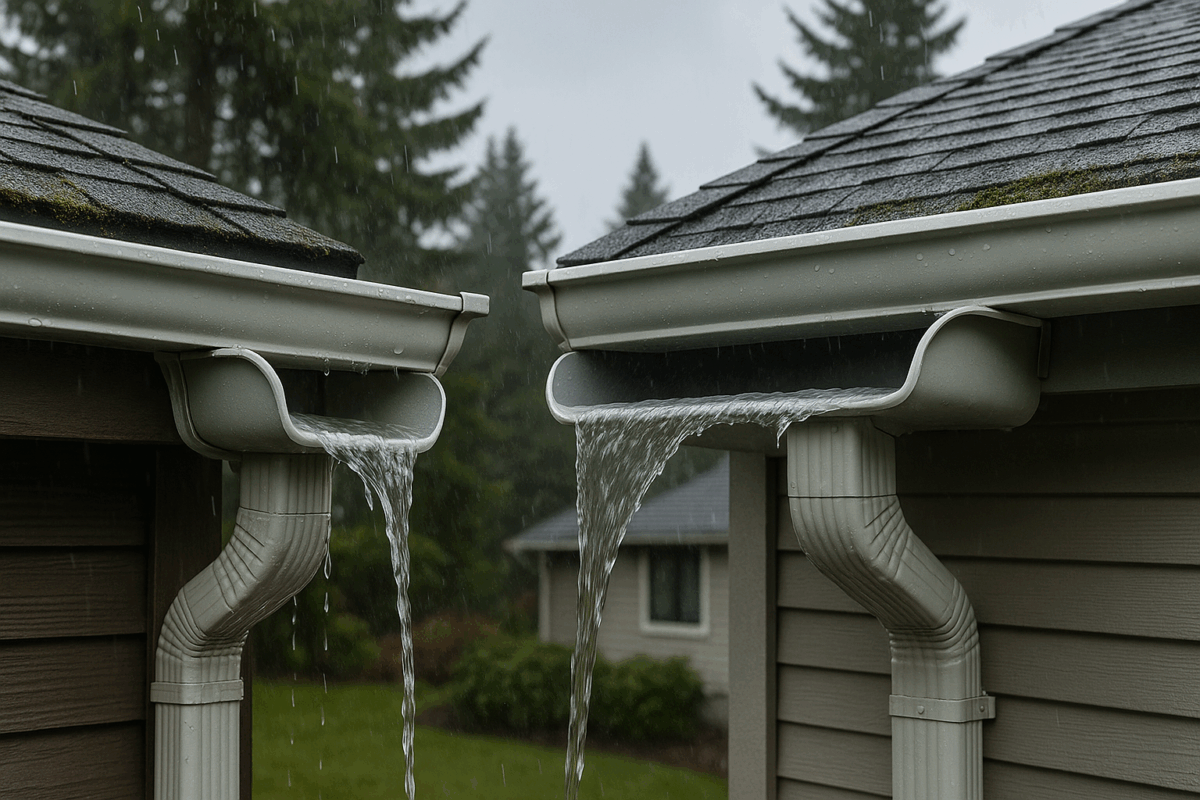
Washington homeowners get used to long rainy stretches, but the storms of recent years have been different. NOAA tracks a rising pattern of severe weather, showing the state now averages more than two major climate events per year. The National Weather Service often reports multi-day systems dropping several inches of rain across Puget Sound.
Those conditions feel normal here, yet they create the perfect setup for clogged gutters. When water has no clear path off the roofline, it stays where it should not stay. Moisture settles into fascia boards, seeps under shingles, and starts the slow process that eventually becomes roof rot.
Many homeowners think roof problems begin only when water shows up inside. However, the early damage happens outside, around the eaves, long before interior stains appear.
This blog follows that chain from storms to debris to trapped water to structural decay, and shows how a reliable gutter cleaning service helps break it.
Why Washington Gutters Clog Faster Than Homeowners Expect
Every region has weather patterns, but the Pacific Northwest has a mix that pushes gutter systems to their limits. Storms roll in from the Pacific with heavy moisture, and atmospheric rivers can drop between two and six inches of rain in just a few days.
Winds shake loose needles, twigs, and moss. A roof can look fine from the street, even while debris collects in every corner of the gutter channel.
Wind-Driven Needles
Tall evergreens drop constant needle litter. Wind pushes those needles into gutters, where they mat together and trap more debris.
Moss and Moisture Retention
Cool temperatures keep roof surfaces damp for long periods. Moss thrives in those shaded patches and breaks apart during storms, sending soft clumps straight into the gutter.
Seasonal Leaf Buildup
Autumn leaf fall is heavier in many neighborhoods than homeowners realize. Even if someone clears the big leaves, the smaller fragments keep drifting toward the downspouts.
Downspout Blockages
Quite a few blockages form out of sight inside the downspout elbows. Water backs up silently until overflow starts during a major storm.
Those patterns appear across the region, and homeowners begin searching for gutter cleaning services near them once they notice overflow. It already tells you how common this issue is here. The more debris the system collects, the more vulnerable the roofline becomes.
How Clogged Gutters Turn Into Fascia Damage and Roof Rot
Once gutters fill, everything slows down:
Stage 1: Overflow and Hidden Pooling
Overflow runs over the outer lip or behind the gutter entirely. When this water meets the fascia, the wood absorbs moisture faster than most people expect.
Stage 2: Fascia Softening and Bracket Loosening
As the fascia softens, gutter brackets lose their grip. A sagging section holds even more water, feeding the cycle. Gutters are the first line of defense, and when that line fails, everything connected to it weakens.
Stage 3: Wet Sheathing and Early Rot
Wood sheathing at the roof edge stays damp after each storm. Fungi grow where moisture lingers under shingles and overlapping materials.
Stage 4: Mold Spread in Soffits and Attic Edges
Eventually, moisture creeps further inward. It might show up only as a faint smell or a small shadow on a soffit board.
A gutter cleaner spots these patterns early, especially during seasonal checks. Homeowners often do not see that chain of events until repairs become more complex. That matters because roof-deck repairs cost far more than a routine cleaning.
Warning Signs Washington Homeowners Often Miss
There is a rhythm to how roofline damage appears, and it rarely starts with a leak on the ceiling. Many signs show up at the edges of the home.
- Dark streaks or “tiger stripes” forming on gutter faces
- A slight sag in one section of the gutter
- Moss bands along the roofline that match the path of overflow
- Siding stains at the top corners
- Musty odors indoors after major storm cycles
The True Cost of Ignoring Gutter Maintenance in Washington
A small delay in cleaning does not feel serious. However, repeated delays line up with every wet week, and the total moisture load keeps rising.
Insurance trends illustrate the stakes. The Insurance Information Institute reports that water damage is the second-most common homeowners insurance claim in the country. In the years with complete national data, nearly a quarter of all homeowner claims involved some form of water intrusion. Even shallow water can be destructive. Just one inch of water can trigger up to $25,000 in repair costs.
Most of that comes from hidden structural issues such as softened fascia, rotted sheathing, failing trim, and mold behind panels. Average water-damage claims often exceed $15,000. Policies also frequently exclude “gradual damage” or problems tied to lack of maintenance, meaning the cost often shifts to the homeowner.
That is why ignoring a clogged gutter can turn into a far bigger expense than people expect. Once carpentry and remediation begin, days of labor pile onto materials. And if storms continue while repairs are underway, the home stays vulnerable.
How to Prevent Clogs and Protect Your Roof
Homeowners do not need to overhaul their homes to prevent roof rot. They just need a consistent system.
Most experts recommend cleaning gutters at least twice a year. But Washington’s climate pushes many properties into a three- or four-cleaning schedule. The goal is to keep water moving.
- Flush downspouts fully during each cleaning
- Trim overhanging branches that drop constant debris
- Reinforce loose hangers or brackets
- Inspect fascia boards for early softening
- Address moss growth before it spreads
- Consider an upgrade to seamless gutters for fewer leak points
Seamless Gutters
Seamless gutters remove the joints where leaks normally start. A single continuous run handles heavy rainfall better and resists the slow deterioration that affects sectional seams.
Downspout Design
Correct sizing and proper extensions help water move away from the house. Blocked downspouts undo even the best cleaning because all water ends up pooling near the roofline.
Protect Your Home Before the Next Storm Season
Washington storms will not slow down. Patterns show more intense weather, more debris, and more opportunities for gutters to fail quietly. If a homeowner stays ahead of debris buildup, they stay ahead of roof rot. Clean, inspect, repair weak points, and upgrade when the system struggles to keep up.
If you want help protecting your home from wind and water damage, we can take care of the full process. We inspect gutters, clear blockages, repair sagging sections, and install seamless systems built for Pacific Northwest storms. Contact us at (971) 777-9899 or fill out the form here to schedule service and keep your home safe through the next weather cycle.
Key Takeaways
- Washington’s storm patterns accelerate gutter clogs.
The state now averages multiple billion-dollar weather events each year, increasing rainfall intensity and debris buildup that overwhelms gutters faster than homeowners expect. - Clogged gutters are a leading contributor to fascia damage and roof rot.
When water cannot drain, it pools at the roof edge, soaking fascia boards and roof sheathing long before interior leaks become visible. - Water damage is one of the most common and costly homeowner claims.
National insurance data shows water damage accounts for a significant share of homeowners insurance claims, often resulting in repairs that exceed $15,000. - Even small amounts of trapped water can cause major structural damage.
Just one inch of water intrusion can result in repair costs reaching $25,000 due to hidden rot, mold, and structural deterioration. - Routine gutter cleaning is one of the most effective ways to prevent roof rot.
Regular cleanings, downspout flushing, and early fascia inspections interrupt the moisture–debris cycle before decay spreads. - Seamless gutters and proper downspout design reduce long-term risk.
Fewer seams mean fewer leak points, and correctly sized downspouts help move water away from the roofline during prolonged storms.
Citations
- NOAA National Centers for Environmental Information (NCEI) – Washington State Billion-Dollar Weather & Climate Disasters
https://www.ncei.noaa.gov/access/billions/state-summary/WA - Insurance Information Institute (III) – Homeowners & Renters Insurance Facts and Statistics (Water Damage Claims)
https://www.iii.org/fact-statistic/facts-statistics-homeowners-and-renters-insurance - This Old House – Water Damage Statistics and Cost Impacts
https://www.thisoldhouse.com/foundations/water-damage-statistics