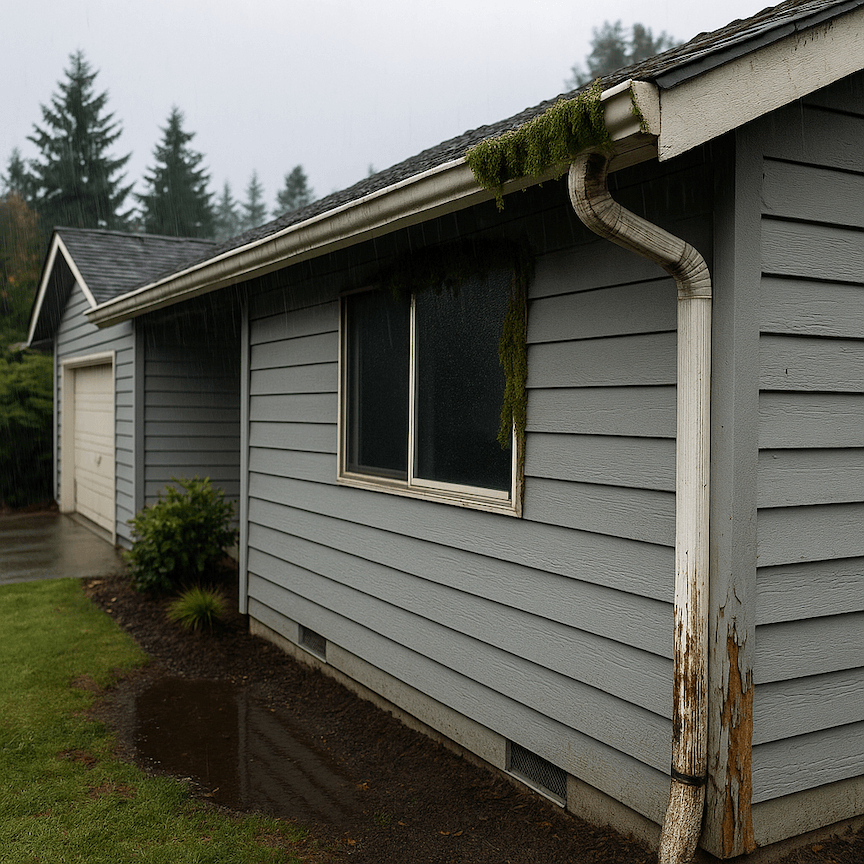
A puddle sitting next to your foundation after a storm does not look dramatic. Most people step around it and move on.
However, in Washington, that small pool often marks the end of a chain reaction that started up at the roof edge. During major Pacific Northwest storms, including a 2024 cyclone that knocked out power to nearly 600,000 people in Washington, exterior drainage systems are heavily tested. Weak spots show up fast.
Chronic pooling is rarely random. Building-science guidance in the U.S. consistently identifies runoff control as the first line of defense against foundation moisture. Small, correctable gutter defects can repeatedly misdirect roof water. That is why many gutter repair calls start with a wet patch near the wall, not a broken gutter section.
We will trace that path step by step so you can spot the risk early and act before the damage grows.
Quick Answer
Water pooling near your foundation usually starts with a minor gutter problem. Clogged downspouts, leaking seams, sagging sections, or short discharge extensions can redirect roof runoff to the base of the home instead of several feet away. In Washington’s heavy rain, repeated misdirected flow quickly saturates the soil, increasing the risk of erosion, foundation moisture, and structural damage. Fixing small gutter issues early restores proper drainage and prevents costly repairs.
The Foundation’s Need: A Dry Perimeter
Every home needs one simple thing at ground level: a dry perimeter. That is the goal behind proper drainage design. Roof water should flow through gutters into downspouts and discharge several feet away from the structure, so the surrounding soil remains stable rather than being soaked.
The best protection against foundation water intrusion is to prevent soil around the foundation from becoming saturated. Recommended grading slopes, about half an inch per foot for ten feet, exist for that reason. Gutters are not optional trim. They are part of the drainage system.
Washington adds pressure to that system. NOAA recorded 27 separate billion-dollar weather disasters across the U.S. in 2024, with 17 tied to severe storms. For homeowners here, that translates into repeated heavy runoff events.
When volume goes up, small gutter weaknesses matter more. That is often when people start searching for gutter repair services near them after they notice water collecting where it never used to.
The Chain Reaction: From Gutter Flaw to Ground Saturation
This process usually starts small. A loose seam. A slightly bent aluminum run. A downspout that drains more slowly than it should. Aluminum gutters hold up well overall, but over time they can bend or sag from debris weight, wind stress, or hanger movement. The change can be subtle at first.
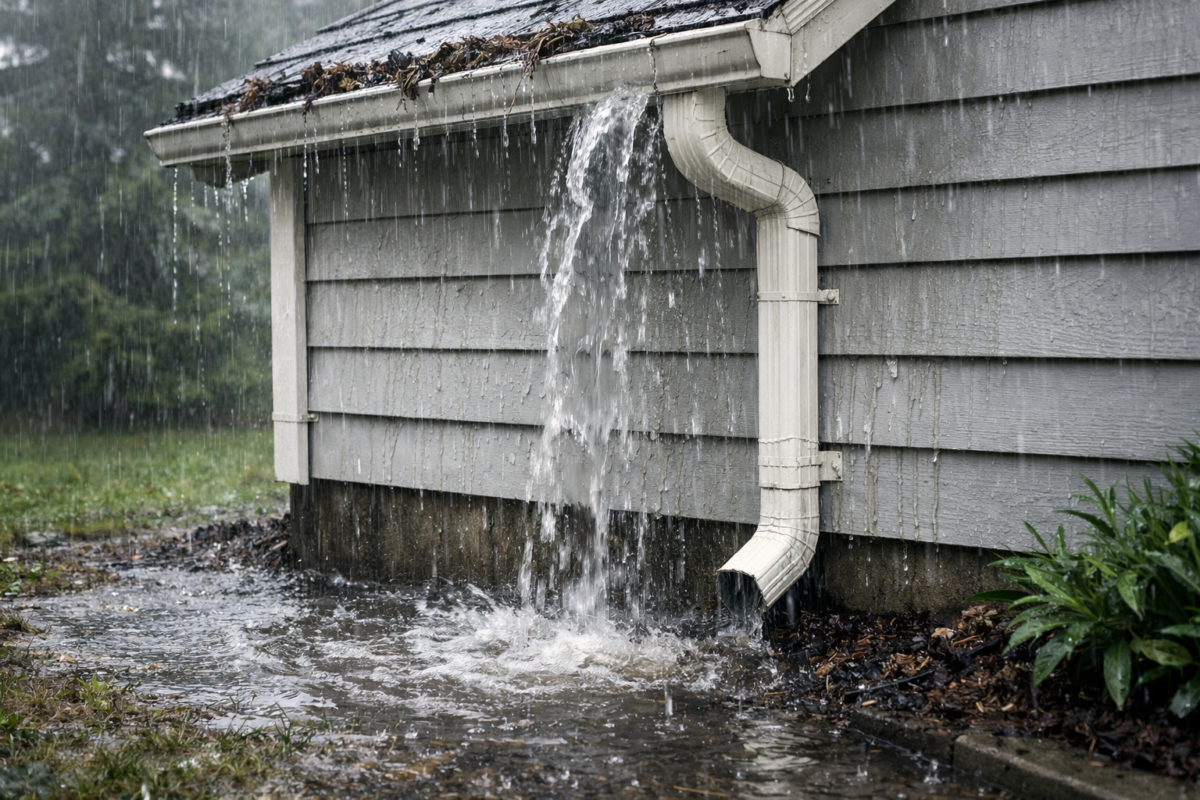
Then the direction of flow changes. Instead of flowing cleanly to the downspout, water seeps through a seam, spills over a low spot, or backs up and overflows the front edge. Gutters and downspouts must stay clear and intact, specifically to keep runoff moving away from the home. When that path breaks, water lands right beside the wall.
After that, the soil takes the hit. One storm might not do much. Repeated storms will. Repeated wetting saturates soil and reduces its ability to absorb more water. Once that happens, you start seeing standing water. The puddle is not the first problem. It is the visible one.
Common “Minor” Issues That Cause Major Problems
Clogged Downspouts
This is the most direct failure point. When a downspout clogs, water has nowhere to go but over the gutter edge or out a seam. Regular gutter and downspout cleaning is recommended to prevent misdirected flow.
In Washington, evergreen needles and storm debris make clogging more frequent, which is why many gutter repair services near you include downspout clearing as a first step.
Leaking Seams/Joints
A seam leak does not look urgent. It drips instead of pouring. Still, that drip line lands in the same strip of soil every storm.
Building-science water management models treat continuous channel flow as essential. Break the channel to create a wet zone at the perimeter. Over time, even aluminum seams can separate slightly due to expansion, contraction, and load stress.
Sagging or Improper Pitch
Gutters must slope enough to move water. When aluminum sections bend or hangers loosen, a low spot forms. Water collects there, then spills over that exact point.
Guidance around drainage always comes back to directional control. Once pitch fails, control fails too. This is one of the most common triggers for a targeted gutter repair rather than a full replacement.
Short or Missing Extensions
Sometimes the gutter works fine, but the discharge point is wrong. Homeowners should watch where water collects during a normal storm. If the downspout ends too close to the house, runoff still saturates the foundation zone. Extensions that carry water farther out often solve pooling without major construction.
From Pooling to Damage: The Escalating Risk
Standing water near a foundation is not just cosmetic. Moving water erodes soil. Unmanaged runoff can erode supporting ground and contribute to settlement around structures.
There is also pressure to think about. Saturated soil pushes against foundation walls. Soil saturation is a primary driver of intrusion risk. When crawl spaces or basements start feeling damp, the issue often stems from exterior water control.
Costs climb fast at that stage. Insurance industry data show that average water damage and freezing claims sit around $15,400 in severity based on recent multi-year averages. Compared to that, targeted gutter repair and early fixes look small.
The Preventative Solution: Inspection and Timely Repair
The useful shift is mental. When you see puddles near the wall, look up before you look down. Observe runoff behavior during an average rainstorm. Where does the water go? Does it overshoot, drip, or spill?
A professional inspection connects those dots. Gutter and drainage systems work as a chain: roof edge, channel, downspout, discharge, and grading. A technician can pinpoint whether the real fix is seam sealing, re-hanging a sagging aluminum run, correcting pitch, or repairing a damaged downspout. Good gutter repair services near you should focus on restoring flow, not just patching metal.
The final layer is distance. Federal runoff guidance emphasizes carrying water several feet away from the structure footprint. Clearing blockages and extending discharge lines often delivers immediate improvement.
Stop the Flow at the Source
Protecting your foundation starts at the roofline, not the slab. Keep water from saturating the soil around the home. Storm data from NOAA and NASA show why this matters even more in regions that experience repeated wind and rain stress.
Small gutter flaws are fixable. Left alone, they redirect water to the worst possible place. We see it all the time, and we fix it at the source. Contact us at Gutter Empire LLC at (971) 777-9899, click here for a free estimate, or use the contact form to schedule your inspection with our team.
Key Takeaways
- Water pooling near a foundation usually begins with small gutter defects such as clogged downspouts, leaking seams, or improper pitch that redirect roof runoff toward the home instead of away from it.
- Washington’s frequent storms and wind events put extra stress on exterior drainage systems, exposing weak gutter connections and flow problems more quickly.¹
- Proper drainage requires gutters to move water into downspouts and discharge it several feet away so the surrounding soil remains stable and unsaturated.
- Repeated runoff in the same location saturates soil, reduces its absorption capacity, and increases the risk of erosion and foundation settlement over time.
- Short or missing downspout extensions are a common cause of pooling even when the gutter itself is functioning correctly.
- Early gutter repairs—such as clearing blockages, resealing seams, correcting slope, or rehanging sagging sections—cost far less than addressing structural water damage later.
- Severe storms and high-runoff events are becoming more common, increasing the importance of maintaining continuous, controlled roof drainage.²
- Water damage and freezing claims remain one of the most frequent and costly homeowners insurance losses, making preventative gutter maintenance a high-value investment.³
Citations
- NASA Earth Observatory – Extratropical Cyclone Over the Pacific Northwest
https://science.nasa.gov/earth/earth-observatory/extratropical-cyclone-whips-over-the-pacific-northwest-153605/ - NOAA National Centers for Environmental Information – Billion-Dollar Weather and Climate Disasters
https://www.ncei.noaa.gov/access/billions/time-series - Insurance Information Institute – Homeowners and Renters Insurance Facts & Statistics
https://www.iii.org/fact-statistic/facts-statistics-homeowners-and-renters-insurance