
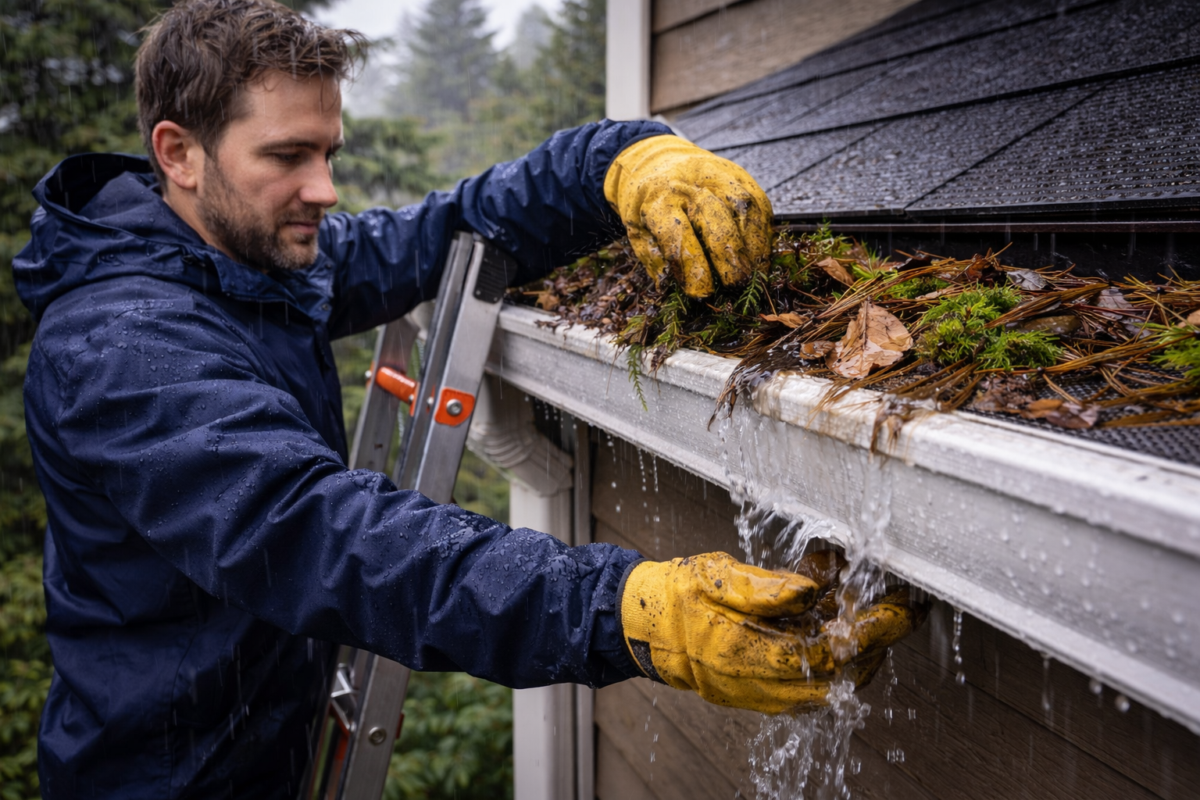
Washington looks peaceful from the outside. Tall evergreens, wet air, and rain that feels constant but almost normal once you live here long enough.
The problem is that gutters experience all of that up close. Needles fall every day, leaves show up even when it is not “fall,” and rain keeps coming back before things ever dry out.
That is why basic twice-a-year gutter cleaning often misses the reality for many Washington homes. The environment works against a neat seasonal schedule.
In this article, we will walk through the signs that your gutters need attention sooner and why changing your cleaning frequency can help protect your home before overflow and water damage start to accumulate.
Quick Answer
Washington’s wet climate, heavy tree canopy, and recurring atmospheric river storms cause gutters to clog faster than standard twice-per-year schedules account for. This guide explains the real-world signs that gutters need more frequent cleaning — including overflow, visible debris, sagging, and pest activity — and why increasing cleaning frequency helps prevent fascia rot, foundation saturation, and system failure.
Key Warning Signs Your Gutters Need Cleaning Sooner
Some gutter problems announce themselves loudly. Others start quietly, then become obvious during the wrong storm. Washington has enough rain that you do not get many second chances.
The Evidence of Overflow
The clearest warning sign is also the most immediate.
You stand outside during a storm and see water spilling over the edge instead of moving through the downspouts. That is not just messy. It means flow is already restricted.
Even small clogs matter here because Washington rain events can be intense. A few inches of rainfall on a roof can create several thousand gallons of runoff. Gutters have one job: carry that water away instead of letting it pour straight down the exterior.
And storms in Washington do not always arrive gently. In December 2025, parts of the Olympics and Cascades received more than 10 inches of precipitation in a few days, with multiple rivers reaching record flood levels.
When rain comes like that, clogged gutters are no longer a minor issue. Overflow can hit fascia boards, soak siding, and send water right to the foundation in real time.
At that point, calling a local gutter cleaning service near you becomes mandatory.
Visible Debris Accumulation
Sometimes you notice the problem before the storm even starts.
Maybe you look up, and the gutters appear full. Dark clumps sit along the channel. You might even spot little bits of moss or plant growth.
That buildup tells you debris has been sitting long enough to hold moisture. And in Washington, moisture sticks around. Organic material does not just dry out and disappear. It compacts.
Tree cover is one reason this happens faster here. Urban Washington averages about 33% tree canopy. That means debris falls constantly, not once a year. Pine needles, leaves, cones, twigs. The gutters keep collecting.
Over time, that weight strains the system, and the trapped moisture accelerates rust and wood rot. If you keep seeing this, you likely need more frequent gutter cleaning services, not just a seasonal check.
Sagging or Pull-Away
Gutters should stay tight to the roofline. When sections start bending downward, something is weighing them down.
Wet debris gets heavy fast. Rain turns loose leaves and needles into dense-packed material. That weight stresses the hangers and fasteners until they fail.
When gutters sag, the risk is not just performance. Detachment can happen. Repairs become expensive. This is where gutter cleaning and repair often overlap, because cleaning alone may not address the strain damage that has already begun.
Animal or Pest Activity
One sign that people do not always connect with gutters is the presence of pests. Birds start hovering near the eaves. Rodents find nesting material. Insects show up more around the roof edge.
Clogged gutters create the perfect setup: wet organic debris, shelter, and sometimes standing water. That attracts pests because it gives them both cover and resources.
The urgency is that pests can worsen blockages, damage roof edges, and sometimes enter attic spaces. In a climate where gutters stay damp for long stretches, these nesting conditions last longer than they would in a dry region.
Why the “Standard” Schedule Fails in Washington
Washington is not a place where gutters only fill up in October. The environment does not work that way.
Heavy Tree Canopy Coverage
The tree canopy alone changes everything. Urban areas average about 33% coverage, and Washington is more than half forested overall. Many homes are subject to constant debris fall.
Needles do not politely wait for autumn. They drop year-round. Leaves show up in waves. The gutters refill continuously, making a twice-a-year routine feel unrealistic for many neighborhoods.
Frequent and Heavy Rainfall
Heavy rainfall washes debris into corners and downspouts. It also compresses existing clogs into thick, heavy masses.
During the December 2025 atmospheric river cycle, over 100,000 residents were placed under evacuation notice in some areas. Even if your home never floods like that, the lesson still matters. When rain intensifies, gutters must function perfectly. Even partial clogs can fail.
That is why homeowners dealing with recurring clogged gutters often need cleaning more often than the calendar suggests.
Moss and Algae Growth
Washington’s climate encourages moss growth on roofs and algae buildup inside gutters. That adds another layer of clogging material, in addition to leaves and needles.
Moss does not flush easily. It builds slowly, stays wet, and thickens into a stubborn organic blockage. It is another reason many homeowners choose professional gutter cleaning over treating it as an occasional chore.
The Proactive Benefits of Increased Cleaning Frequency
Cleaning more often is not about perfection. It is about avoiding preventable damage.
Prevents Costly Water Damage
Roof runoff must be directed away from the home to prevent soil saturation, mold growth, and durability issues. In Washington, water keeps coming back. If overflow happens repeatedly, fascia rot and foundation erosion become much more likely.
Preserves Your Gutter System
Frequent cleaning reduces strain on seams, hangers, and attachment points. It prevents the heavy buildup that causes sagging and pull-away. That preservation matters because replacing gutters costs far more than maintaining them.
Saves Money Long-Term
Extra cleanings cost less than major repairs. Fixing fascia boards, correcting drainage issues, or addressing water intrusion can add up quickly. Staying ahead with a regular gutter cleaning service near you usually saves money over time.
Take Control of Your Gutter Schedule
Recognizing these signs is the first step in adapting your home maintenance to Washington’s demanding environment. When you clean more often, you stop reacting to overflow and start protecting your home before damage becomes routine.
If you are seeing repeated buildup, overflow, or sagging, we can help. Contact Gutter Empire LLC to schedule professional gutter cleaning and repair services. Call us at (971) 777-9899, click here for a free estimate, or contact us to ensure your gutters are ready for the next stretch of rain.
Key Takeaways
- Washington’s heavy rainfall and atmospheric river events can overwhelm partially clogged gutters very quickly.
- Overflow during storms is the clearest sign that gutter cleaning is already overdue.
- Visible debris, moss, and plant growth indicate moisture-retaining buildup that accelerates gutter and fascia damage.
- Sagging or pull-away sections often mean wet debris weight is stressing brackets and fasteners.
- Pest activity near the roofline often signals clogged, organic-filled gutters.
- Due to high tree canopy coverage and year-round needle drop, many Washington homes need cleaning more than twice per year.
- More frequent cleaning helps prevent water damage, preserve gutter structure, and reduce long-term repair costs.
Citations
- CW3E Atmospheric River Summary – December 2025 precipitation and atmospheric river impacts in the Pacific Northwest
https://cw3e.ucsd.edu/wp-content/uploads/2025/12/23Dec2025_Summary/23Dec2025_Summary.pdf - Washington State Department of Natural Resources — Tree canopy and statewide tree coverage metrics
https://dnr.wa.gov/news/2025/american-forests-washington-state-department-natural-resources-launch-statewide-tree-equity-score - University of Washington Climate Impacts Group — December 8–11, 2025 heavy rainfall and flooding historical context
https://climate.uw.edu/2026/01/13/december-8-11-2025-heavy-rainfall-and-flooding-historical-context-and-a-note-on-snow-drought/