
Coastal Washington has a way of chewing through home exteriors that looks “fine” at first. Then a big rain hits, wind pushes water sideways, and suddenly a seam drips, a corner separates, or an end cap starts letting water slip behind the gutter. That is the frustrating part. Gutters can fail quietly for months, then show it all at once.
A big reason is coastal air. Salt in the air leaves residue on metal and hardware, and that residue keeps working on the system every time the weather turns wet again. In Washington, the weather turns wet again a lot.
If you are choosing between repairs and upgrades, it helps to know what is happening up there. This is the kind of thing gutter installation companies see all the time in wind-exposed neighborhoods, especially on taller homes where gutters take more force and are harder to inspect closely.
The Real Culprit: Salt Air (Chlorides) + Metal Exposure
Coastal air carries tiny salt particles that settle on exterior surfaces. The main issue is chloride. Chloride makes corrosion more aggressive, especially where metal is exposed or where water lingers. A gutter system has plenty of those spots.
Salt residue does not need a dramatic splash to cause problems. It sits on the gutter surface, on fasteners, and around joints. When rain or mist wets that residue, it becomes more reactive. Then the sun and wind dry it out again, leaving more concentrated deposits behind. That cycle repeats, and the damage stacks.
Sea-spray aerosols can remain airborne for over 15 miles. People often assume “coastal” only means homes right on the beach. Salty air can reach inland communities depending on wind patterns and local geography.
That is why local conditions matter. The right gutter installation services near you should account for salt air, wind-driven rain, and repeated wet–dry cycles.
Why Washington’s Weather Makes Coastal Wear Show Up Faster
The coast is not just wet. It is wet, then breezy, then wet again. Those wet–dry cycles are perfect for concentrating salt on metal surfaces.
NOAA’s Weather Prediction Center described western Washington storm conditions where rainfall rates could surpass 0.5 inches per hour and locally approach 1 inch per hour. It also referenced short-window totals in the 2–5-inch range, with 48-hour totals of 5–7 inches in that pattern.
When rainfall comes down that fast, weak points do not get a gentle test. They get a full stress test. Water piles up, flow speed changes, and overflow becomes more likely.
Now add wind. During a late-Dec 2025 storm sequence affecting the Northwest, reporting cited gusts up to 85 mph. High winds can tug at gutters, flex corners, and rattle end caps, especially when the gutter is already carrying a heavy load of water.
Over time, that is how a minor loosening turns into a visible drip, then a bigger leak, then a repair that keeps coming back. At that point, homeowners start thinking about gutter replacement because patching feels endless.
Where Gutters Break First: Seams, Fasteners, End Caps, and Corners
Gutters rarely fail “in the middle.” They fail where pieces connect and where hardware holds everything in place. Coastal air and windstorms target those locations first because they combine exposure, movement, and trapped moisture.
Seam and Joint Creep (Micro-Gaps)
Sectional gutters have more joints by design. Every joint is a potential leak pathway. Even if the sealant holds at first, wind-driven rain and repeated runoff cycles can work into the smallest gaps. The leak might not show on light rain days. It shows when the flow volume increases and water starts pressing against every seam.
Fastener Corrosion and Loosening
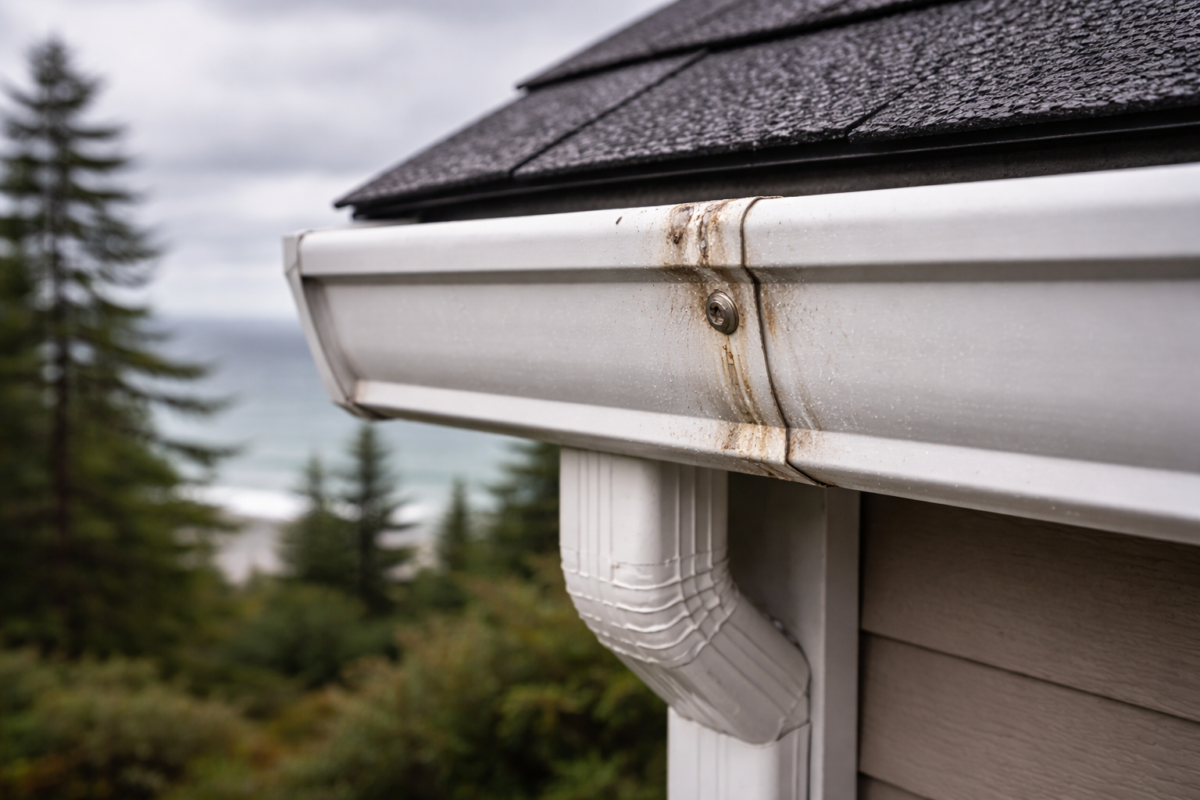
Fasteners are small, but they do a big job. Once a fastener corrodes, it can lose grip. Then the gutter moves more, which makes seams and end caps work harder. This is one reason storm seasons can suddenly reveal multiple issues at once.
End-Cap and Corner Fatigue Under Wind
When wind and water hit the gutter line, end caps can flex, loosen, or start leaking at the edges. If the home is multi-story, the system often sees more wind exposure, and small movements can repeat over and over. Missing or loose end caps create a simple but serious problem: Water escapes where it is not supposed to.
Warning Signs That Coastal Wear Is Turning Into Damage Risk
Coastal wear does not always look dramatic, so it helps to know the specific signals that show the system is starting to lose its seal.
- Rust staining around screws or hangers, especially near corners and ends
- White, chalky residue or pitting on metal surfaces, which can suggest the finish is breaking down
- Drips that appear only during heavier rain, not during light showers
- Water marks on fascia or streaks down siding right below an end cap or corner
- Frequent “new leaks” in different spots, which can mean multiple joints are starting to fail
- Overflow that shows up during fast rainfall events when flow volume spikes
When end caps loosen, water can spill behind the gutter and run down the exterior wall. That can stain siding, soften trim, or keep the fascia area damp longer than it should be. At ground level, the same leak can dump water in the wrong place, increasing the risk of pooling near the foundation.
Materials + Design Choices That Hold Up Longer
After you spot the weak points, the next question is straightforward: What lasts longer in salty, stormy conditions?
A significant advantage comes from reducing connection points. Fewer seams mean fewer places for water to force its way through during heavy rain and wind-driven storms. That is why seamless gutters tend to make sense in coastal or high-humidity areas. They simplify the system, and they cut down the number of “first-to-fail” zones.
Material choice also matters, but not in a magic way. It is about durability under repeated exposure. Aluminum gutter installation is often part of a more coastal-ready approach because aluminum can offer strong performance in exterior conditions when installed well and maintained appropriately. The point is not that one material never wears out. The point is that some setups tolerate the environment better and stay tight longer.
Even the best material still needs solid installation. Pitch, fastening method, and how end caps and corners are secured all matter. Coastal storm cycles punish anything that is even slightly loose, so a “good enough” install can turn into frequent leak chasing.
Protect Your Home Before the Next Coastal Storm Cycle
Most homeowners do not want to think about gutters until they see water where it should not be. That is normal. But in Washington’s coastal conditions, waiting for a visible leak often means the system has already been taking damage for a while.
If you want a system that holds up better through Washington’s storm cycles, we can help. Gutter Empire LLC can help secure and reinforce gutter systems for coastal exposure, including repairs that address end-cap leaks and upgrades like seamless runs when the old setup keeps failing. Contact us at (971) 777-9899, or get a free estimate here, for an evaluation and recommendations based on the conditions around your property.
Key Takeaways
- Coastal salt air accelerates gutter corrosion and wear.
Salt-rich coastal air leaves chloride residue on gutters, seams, and fasteners. When it repeatedly cycles through wet–dry conditions, it increases corrosion and speeds up gutter deterioration — especially at connection points and exposed metal surfaces. - Heavy Washington storm cycles expose weak gutter points quickly.
Western Washington can see intense rainfall bursts, rapid accumulation, and periods of wind-driven rain. During these events, seams, joints, end caps, and fasteners experience high stress — which is when leaks and separation often become visible. - Wind gusts amplify damage to gutters already weakened by corrosion.
Strong wind events — including storm patterns producing widespread damage and infrastructure failure across coastal communities — can flex gutter runs, loosen fasteners, and rattle corners and end caps, especially on taller homes and wind-exposed properties. - Gutter systems usually fail at seams, fasteners, corners, and end caps — not mid-run.
These areas combine movement, moisture, and salt exposure. Once fasteners loosen or sealant fails, leaks appear during heavier rain rather than light showers. - Seamless gutters and reinforced fastening reduce long-term leak risk.
Fewer connection points mean fewer failure zones, and aluminum seamless gutter installation with proper fastening and slope performs better in windy coastal environments than older sectional systems.
Citations
- Atmospheric corrosion & chloride exposure in marine environments — Defense Systems Information Analysis Center
https://dsiac.dtic.mil/articles/atmospheric-corrosion-severity-and-the-role-of-the-environment-determining-a-direct-correlation/ - NOAA Weather Prediction Center — heavy rainfall & storm pattern discussion
https://www.wpc.ncep.noaa.gov/metwatch/metwatch_mpd_multi.php?md=1177&yr=2024 - AP News — Pacific Northwest storms, flooding, and high-wind regional impacts
https://apnews.com/article/pacific-northwest-levee-floods-washington-idaho-fe814b86139b6d30b8e19f5f1d44e47e