
When you’re managing a large commercial property in Washington, you already know the rain is relentless. What you might not think about as often is what all that water is doing to your building, specifically, what happens when the gutters and downspouts aren’t built for the job.
On a big commercial roof, that’s not a minor inconvenience. It’s the kind of thing that quietly leads to foundation damage, rotting fascia, and five-figure repair bills.
Commercial gutters and downspouts aren’t just bigger versions of what you’d find on a house. They’re engineered around a completely different set of drainage demands. Understanding what that difference looks like and why it matters in this region is the first step toward making smart decisions about your property.
Quick Answer Summary
Heavy-duty gutters and downspouts are essential for large commercial buildings because they manage far greater water volume than residential systems. Large roofs can generate thousands of gallons of runoff during a storm, requiring wider gutter profiles, stronger materials, and properly spaced downspouts to prevent overflow and structural damage. When sized and installed correctly, commercial drainage systems protect foundations, siding, and roofing systems from costly water-related damage.
Why Gutter Sizes Matter More on Large Buildings
Here’s where the math gets telling. For every 100 square feet of roof surface, one inch of rain produces 62 gallons of runoff. A 900-square-foot barn roof generates 558 gallons per inch.
On a 20,000-square-foot commercial roof, design flow can rise dramatically once roof pitch and local rainfall intensity are factored into commercial drainage calculations. In one sizing example, that load reaches about 1,880 gallons per minute.
Standard 5-inch gutters hold about 1.2 gallons per linear foot. A 6-inch gutter holds around 2.0 gallons per foot, a 67% jump in capacity. At a commercial scale, that difference stops being academic. A section of undersized gutter on a long roof run can become an overflow point in minutes, and once water starts spilling over the edge, it’s heading straight for your fascia boards, your siding, and eventually your foundation.
The overflow problem compounds on properties where roof spans are long, and downspouts are too far apart. Water backs up, sits in the trough, and finds the weakest point. That’s how small installation decisions turn into expensive structural repairs.
What Makes Commercial Gutters and Downspouts Different
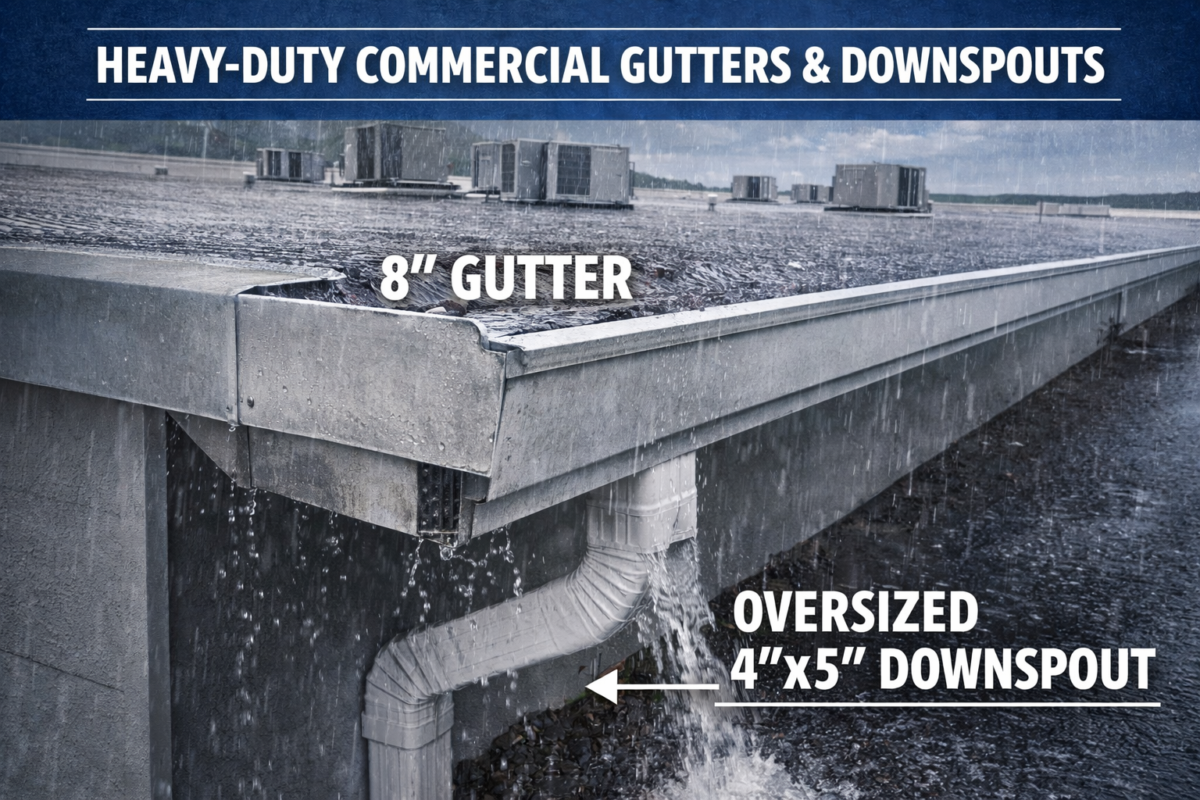
Heavy-duty gutters and downspouts designed for commercial properties start where residential systems leave off. While 5-inch and 6-inch K-style gutters serve most homes, commercial applications typically call for 7-inch or 8-inch K-style profiles. For flat roofs or buildings with parapet walls, box gutters are designed to carry much higher volumes of water.
Material matters, too. Commercial-grade systems often use heavier aluminum, such as 0.032- or 0.040-inch material, or galvanized steel in heavier commercial gauges such as 24 gauge. Lifespan varies by material and maintenance. Still, aluminum and steel systems often last around 20 years, while premium metals can last for decades beyond that. In a region where the system is under load for five or six months straight, that durability matters.
Downspout sizing scales up as well. Whereas a standard home uses a 2×3-inch downspout, commercial gutters and downspouts commonly require 3×4-inch or 4×5-inch profiles to match the volume from larger gutter channels. It’s not just about width; the downspout’s outlet capacity must keep pace with what the gutter collects, or the whole system backs up.
Washington’s plumbing code sizes storm drainage based on projected roof area and local rainfall data, and secondary roof drainage components are generally sized using double the local rainfall rate. Commercial gutter installation done right doesn’t just follow these standards. It anticipates them.
Improper Drainage Costs Property Owners More Than the Fix
It’s easy to think of gutter installation as a maintenance expense. The reality is that undersized or poorly installed commercial gutters are a liability.
Water damage in commercial buildings escalates quickly once it goes unnoticed. In office environments, restoration costs average about $15,000 per incident, but when leaks remain undetected, something that typically takes around three weeks, the average cost rises to roughly $28,500.
Clogged or overflowing gutters also play a measurable role in building damage. Research links them to 13% of exterior wall water intrusion cases, while poor site drainage contributes to 16% of basement flooding incidents. Repairs tied to moisture around the foundation can easily run into the several-thousand-dollar range, depending on the severity of the structural damage.
The structural wear from prolonged water exposure is gradual and easy to miss until it isn’t. Fascia boards saturate and rot. Siding takes on moisture behind the surface. Foundations shift as soil erodes from repeated overflow. A properly sized commercial gutter installation addresses all this upstream.
Getting Downspout Placement Right Is Just as Critical as Gutter Size
Even a correctly sized gutter system fails if the downspouts can’t keep up. Outlet sizing and placement directly determine how fast the system clears itself during a storm.
A 6-inch K-style gutter can handle up to 7,960 square feet of roof drainage area per downspout. Industry standards call for one downspout per 40 linear feet of gutter at a minimum, more in high-volume scenarios. Adding a single 2×3-inch rectangular downspout to an existing run can boost drainage capacity by 600 square feet. On a large commercial roof generating close to 1,880 gallons per minute, such a calculation can mean the difference between a functional system and one that overflows whenever the rain picks up.
Roof pitch also plays into this. Steeper pitches accelerate the rate at which water reaches the gutter, which means the gutter and downspout need to move it out even faster. Commercial gutter installation professionals account for the pitch factor, total drainage area, local rainfall intensity, and downspout placement together, as no single variable operates in isolation.
Protect Your Property Before the Next Storm Hits
Washington’s wet season is long, and large commercial properties take the full force of it. The difference between a system that handles that load and one that doesn’t comes down to gutter profile, material gauge, downspout sizing, and how well the installation accounts for your specific roof geometry and local rainfall conditions.
Heavy-duty gutters and downspouts sized for commercial use aren’t an upgrade. They’re the right tool for the job. When the gutters work, water moves away from your structure the way it’s supposed to. When they don’t, the costs stack up in completely avoidable ways.
At Gutter Empire, we specialize in commercial gutters and downspouts built for Washington’s wet season. Call us at (971) 777-9899, click here for a free estimate, or reach out through our contact form to schedule your assessment.
Key Takeaways
- Large roofs produce enormous runoff volumes. One inch of rain on 100 square feet of roof generates about 62 gallons of water, making drainage design critical for large commercial properties.¹
- Commercial gutters typically use 7- or 8-inch profiles and larger downspouts (3×4 or 4×5 inches) to handle higher water loads compared with residential systems.
- Washington building codes size storm drainage systems based on roof area, rainfall intensity, and local conditions, ensuring gutters and downspouts can handle peak storm events.²
- Undersized or poorly installed systems often lead to overflow, fascia rot, siding damage, and foundation moisture problems.
- Water damage can escalate quickly in commercial buildings, with average restoration costs rising from roughly $15,000 to over $28,000 when leaks go undetected for weeks.³
- Research shows clogged or overflowing gutters contribute to about 13% of exterior wall water intrusion cases, highlighting the importance of properly designed drainage systems.³
- Correct downspout spacing is critical; commercial drainage design often requires one downspout per roughly 40 feet of gutter, with adjustments based on roof size and rainfall intensity.
Citations
- Washington State University Extension – Roof runoff and water flow calculations
https://extension.wsu.edu/clark/naturalresources/smallacreageprogram/managing-roof-runoff/ - Washington Administrative Code – Storm drainage sizing requirements
https://app.leg.wa.gov/wac/default.aspx?cite=51-56-1100 - Gitnux – Water damage statistics and building impact data
https://gitnux.org/water-damage-statistics/